

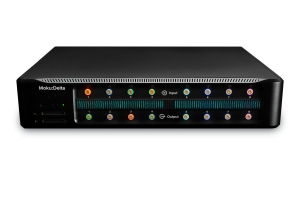
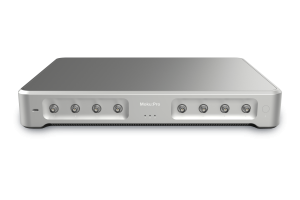
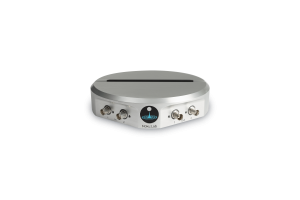
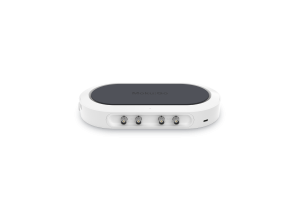

Almost everyone who has a passing interest in physics has heard of the Heisenberg uncertainty principle. In its most famous postulation, it relates the fundamental uncertainty in the knowledge of both a particle’s momentum and position, simultaneously. The product of the uncertainties has a lower bound; improving precision in measurement of one value generally reduces precision in the other. Even approaching the quantum limit is tricky, but researchers across the world are determined to improve their measurement techniques until it is reached. Investigation into this fundamental problem has given rise to the field of quantum metrology.One team at Shanghai Jiao Tong University recently published work in Nature Communications detailing their tremendous progress in the field of quantum metrology. To accelerate their research, the group members are using Moku:Lab, an FPGA-based test and measurement device that delivers more than 15 software-defined instruments. Leveraging the Spectrum Analyzer and Lock-in Amplifier instruments, the team has discovered a clever new way to mitigate the fundamental limitations imposed by quantum mechanics and improve precision in multiparameter estimation.
The challenge
Quantum metrology is a field of physics research that harnesses concepts of quantum mechanics, particularly superposition and entanglement, to enhance the accuracy of measurements beyond classical limits. A cornerstone of quantum metrology is the concept of quantum parameter estimation (QPE).The QPE process is detailed in Fig. 1. An initial quantum state, known as the probe state, undergoes an evolution into a final state, called the parametrized state. Information about the factors contributing to the evolution of the state (the parameters) can be deduced by measuring the parametrized state. With careful selection of the measurement, researchers can estimate one or more parameters with the maximum precision allowed, called the Quantum Cramér-Rao (QCR) bounds. However, when the estimated parameters are incompatible, or non-commuting, a much tighter restriction is placed on the measurement, and one is unable to achieve the QCR bounds for all parameters involved. Since the most well-known combination of incompatible parameters are position and momentum, if a probe state undergoes both a position and momentum shift, the values of the parameters cannot both be determined with optimal precision.

Figure 1: The quantum parameter estimation measurement sequence. Figure reproduced from publication1.
The solution
Researchers in the group of Professor Guihua Zeng have found that while the fundamental underlying physics are as rigid as ever, the limitations can be mitigated through manipulation of the probe state. First the team created a probe using a superposition state of the laser beam, with horizontal (H) and vertical (V) polarizations as the classical 0 and 1 states. They then sent the probe state into a Mach-Zehnder interferometer (MZI), pictured in Fig. 2.

Figure 2: The Mach-Zehnder interferometer used in the team’s experiments. The Moku:Lab Spectrum Analyzer and Lock-in Amplifier instruments are indicated. Figure reproduced from publication1.An MZI uses a polarization beam splitter (PBS) to split the signal into two paths, which are later recombined through another beamsplitter. When recombined, the two beams will constructively or destructively interfere depending on their relative phase. The signal is then collected by two photodetectors (PD). From that, researchers can deduce the difference between the beam paths. In one arm of the MZI, the team placed a piezoelectric device to give the beam a small displacement and angular rotation — a “kick” in both position and momentum. The magnitude of these parameters could normally be determined individually by measuring the final state and comparing it with the initial probe state. However, since position and momentum are incompatible parameters, they both cannot be measured simultaneously with optimal precision. The workaround the team came up with was to depart from a traditional Gaussian laser beam profile. The team found that using higher-order Hermite-Gaussian (HG) laser beam profiles as the probe states meant that the piezoelectric device imparted a larger variance in the momentum and position kicks to the system, which allowed them to estimate incompatible parameters more precisely. Increasing the number of modes of the beam allowed them to approach closer to the quantum limit, as seen in Fig. 3.

Figure 3: Multiparameter estimation. The plot of the measured variance in momentum (y-axis) vs. position (x-axis). The dotted lines correspond to the ideal scenario where the parameter can be measured with minimal precision. Increasing the number of modes of the Hermite-Gaussian beam brings the experimental result (yellow dot) closer to the quantum limit (red dot). Figure reproduced from publication1.As part of the group’s efforts, Ph.D. student Binke Xia leveraged the Moku:Lab Spectrum Analyzer and Lock-in Amplifier instruments in the measurement chain. The Lock-in Amplifier assists in calibrating the interferometer by measuring the path difference between the branches. After the photodiode collects the demodulated interferometer signal and passes it to Moku:Lab, the Spectrum Analyzer performs real-time analysis of the signal-to-noise ratio (SNR). The magnitude of the SNR is related to the size of the position and momentum shifts of the beam. “Real-time calculation of the SNR was critical,” Xia said. “It allowed us to make time-sensitive measurements.”
The result
While the principles of the Heisenberg uncertainty principle cannot ever be fully subverted, progress has been made in the connection between it and quantum multiparameter estimation. By leveraging high-order Hermite-Gaussian states as probes, the team successfully demonstrated the simultaneous estimation of spatial displacement and angular tilt of light with remarkable precision, down to 1.45 nm and 4.08 nrad, respectively. The team sees a future for Moku devices in the search to further improve these measurements. Lately, Xia has been looking at implementing more features of the group’s new Moku:Pro into his experiments, including developing custom algorithms with Moku Cloud Compile. He is also looking forward to using the Laser Lock Box instrument, stating that it could be a useful tool for the field of quantum metrology as a whole.
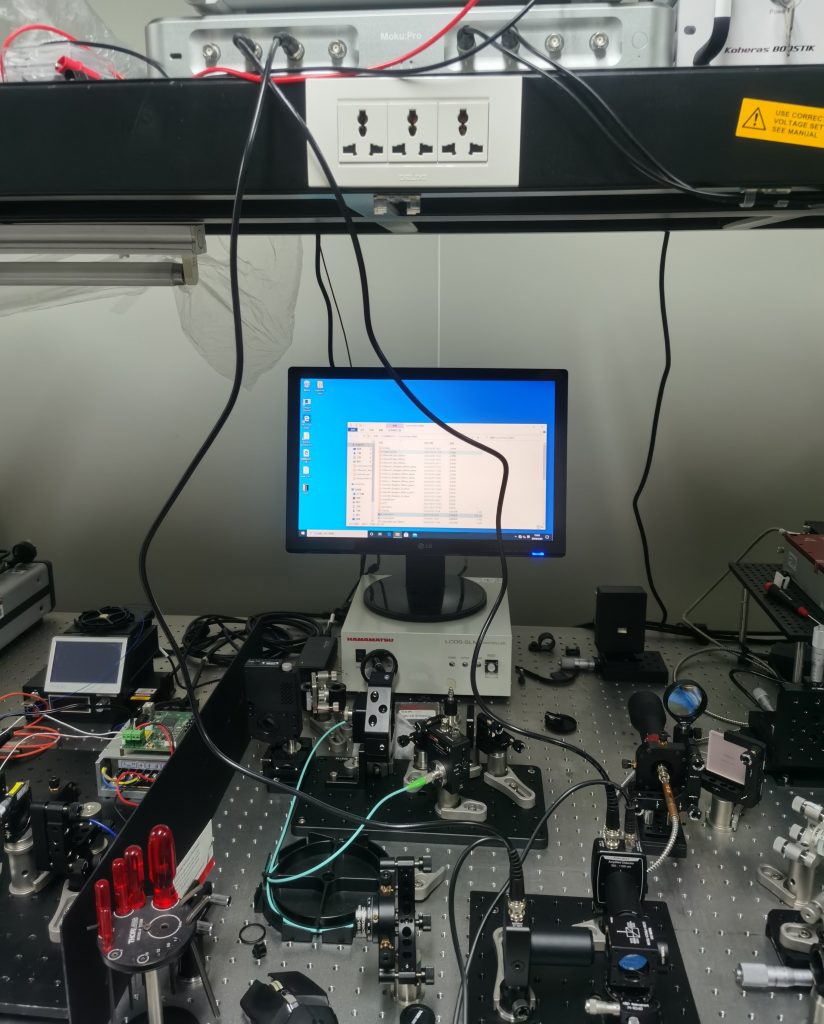
Figure 4. Moku:Pro (located on top rack) integrated into the QPE measurement setup on the optical table. Photo courtesy of Shanghai Jiao Tong University.“It is useful for our ongoing experiments such as the locking of the optical cavity and other precise measurements,” Xia said. “We’d like to deploy it, especially for Moku:Pro, where it can be used to lock multiple laser cavities simultaneously.”To learn more, read the team’s article in Nature Communications.
Questions?
Get answers to FAQs in our Knowledge Base
If you have a question about a device feature or instrument function, check out our extensive Knowledge Base to find the answers you’re looking for. You can also quickly see popular articles and refine your search by product or topic.
Join our User Forum to stay connected
Want to request a new feature? Have a support tip to share? From use case examples to new feature announcements and more, the User Forum is your one-stop shop for product updates, as well as connection to Liquid Instruments and our global user community.
Footnotes
[1] B. Xia, J. Huang, H.Li, H. Wang, G. Zeng, Nat. Commun. 14, 1021, (2023).