


Assisted reproductive technologies (ART) are becoming more prevalent as infertility increases and the birth rate decreases. Oocyte cumulus removal (CR) is an important step in preparing the oocyte for any ART procedure, like intracytoplasmic sperm injection (ICSI) or in vitro fertilization (IVF). Traditional CR methods involve manual pipetting to remove cumulus cells from oocyte, resulting in inconsistent and variable procedures in the clinics that, in turn, affect the fertilization rate.
The Abbaspourrad Lab in the Department of Food Science, College of Agricultural and Life Sciences at Cornell University has designed an open-surface chip with a micropillar array and an XY piezoelectric stage that uses vibration-induced flow (VIF) to conduct oocyte CR. This automates the CR process and therefore reduces the technical labor needed. This method also allows for standardization and consistency in the CR process.
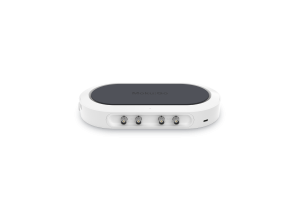
VIF was generated via piezo actuators that are driven in the X- and Y-planes, with each actuator controlling a different plane. In their work, the Moku:Go Waveform Generator was used to induce the vibration by driving the two actuators with sine waves that are 90 ° out of phase with one another. This created a clockwise rotation and allowed for the cumulus cells to be carried to the annulus well via the pillar array, designed on the chip, after separation from the oocyte. Their results were published in Lab on a Chip.
The Challenge
When utilizing ART methods, CR is a crucial step in the process. This step allows the assessment of oocyte fertilization rate after IVF insemination, as well as the ability to evaluate the maturity of the oocyte prior to ICSI. CR also reduces cumulus cell contamination, which leads to more reliable DNA sequencing. [1]
Traditionally, this is done manually by a trained embryologist. An embryologist will use an appropriately sized pipette to manually remove the cumulus cells from the oocyte by flushing the oocyte several times with the pipette. This technique is tedious and when performed incorrectly, it can lead to oocyte loss or damage, including zona pellucida rupture, changing the position of the first polar body (PB), and other adverse effects. Like any manual process, this introduces variability and inconsistency to the CR in the clinics.
Researchers have attempted to overcome this by using microfluidic platforms to automate the process. However, cells are usually lost at the boundary between the chip and the external environment. In addition to being time-consuming, this technique makes cell collection difficult for post-analysis.
Open surface chips were developed as a more cost effective and easy to handle option. Active flow generation often came with using optical, magnetic, or electric forces which still demanded highly skilled technicians to set up and use the equipment. For some techniques, such as the use of magnetic fields, technicians must add a pre-magnetized label to the cell, which is not ideal for cells destined for ART.
A better alternative was to use vibration to remove the cumulus cells from an open surface chip without the need for complex setups and high skill, since loading and collecting the cells is easier.
The Solution
The team developed an open surface chip and an XY piezoelectric stage that could be used to induce VIF and remove the cumulus cells on an open surface chip. Thanks to the benefits of open surface chip, the team could more easily drop the cells into the chip and utilizing an XY piezoelectric stage allows the team to easily apply VIF to the chip for CR.
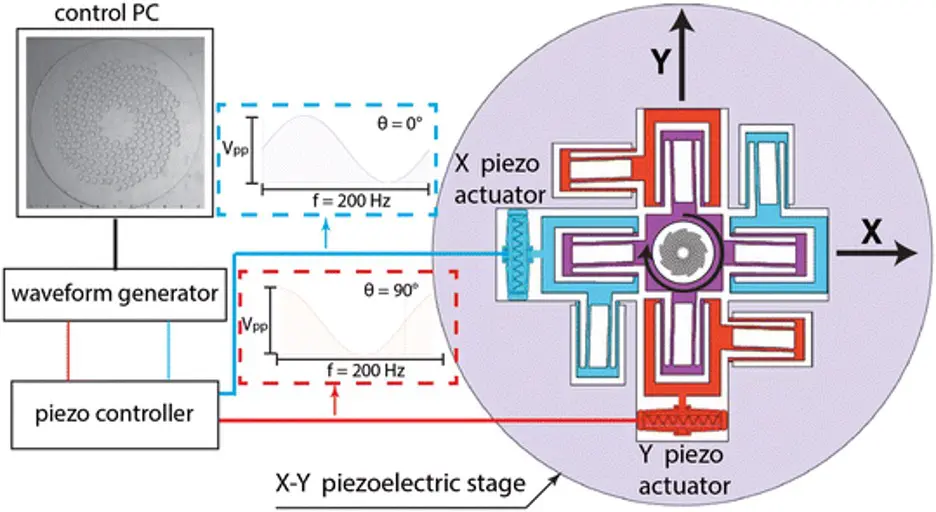
Figure 1. Graphical representation of the experimental setup. The X and Y piezoelectric actuators (PEAs) are driven by sine waves with 90-degree relative phase.
Moku:Go drove the piezoelectric stage; one output drove the X-direction, and the other drove the Y-direction. This gave the team the ability to easily change frequency, phase, and amplitude of their drive signal. By driving the XY piezoelectric stage with sine waves that are 90° apart in phase, the team was able to generate clockwise VIF. Because of the design of the chip, this allowed the cumulus cells to collect in the well on the outside of the chip and leave the denuded oocyte at the center.
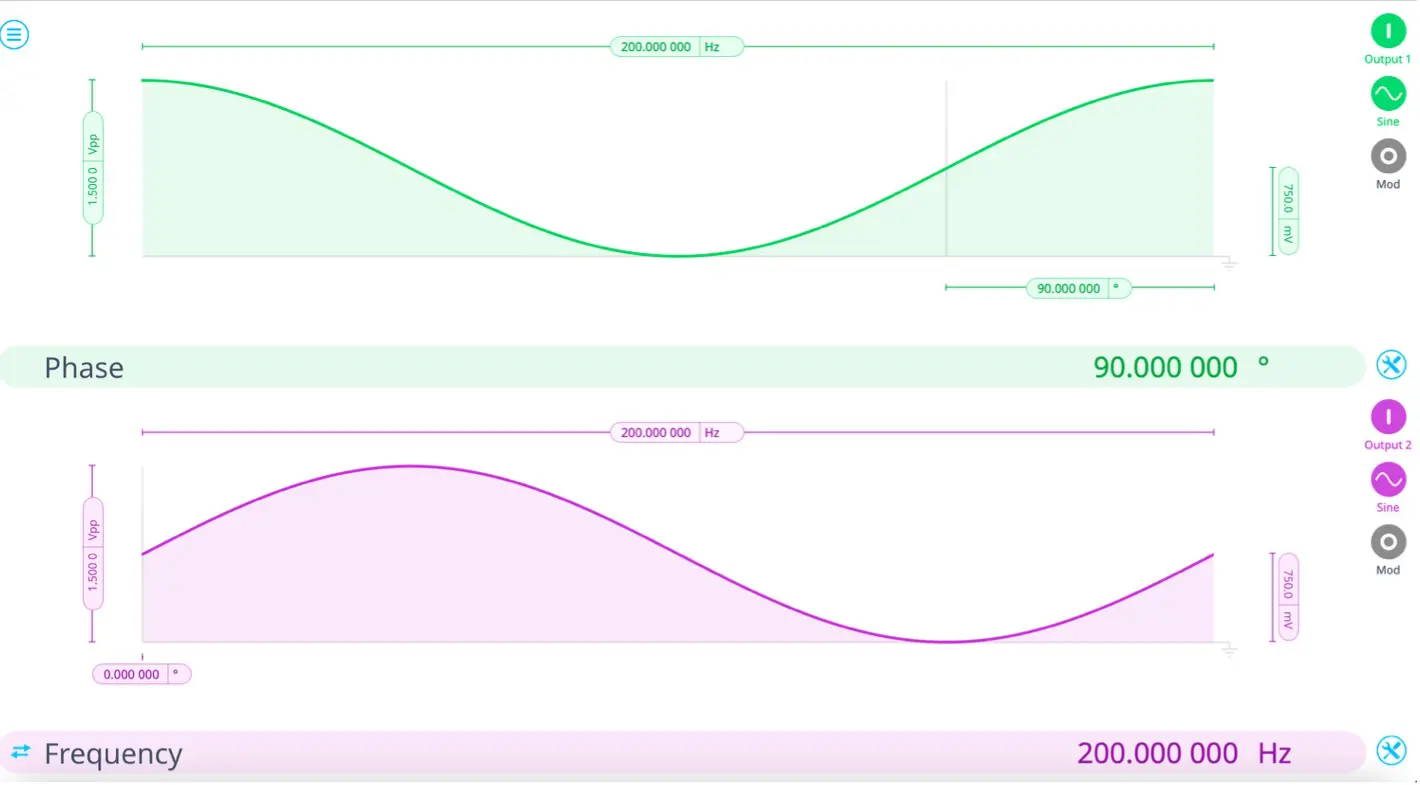
Figure 2. Moku:Go configuration. Moku’s interface allows control over frequency, phase, amplitude, and modulation options.
Using an open surface chip, researchers can more easily load and collect the samples from the chip, eliminating the need for exhaustive prep of the sample. Deciding to use a piezoelectric stage to induce VIF instead of electrical or magnetic forces was due to the ease of setting up. Loading the chip on top of a X-Y piezoelectric stage allows VIF to be induced without directly interacting with the sample which leads to more consistent outcomes and higher throughput.
The Result
The chip’s operating mechanism was tested at 3 voltages: 0.5 Vpp, 1 Vpp, and 1.5 Vpp. The team also studied the velocity of the flow as a function of the voltage. The MokuOS allowed the team to easily change the voltages and frequencies until they found the best streaming effect. The team decided to go with a 200 Hz sine wave at 1.5 Vpp which resulted in the highest cleaning efficiency.
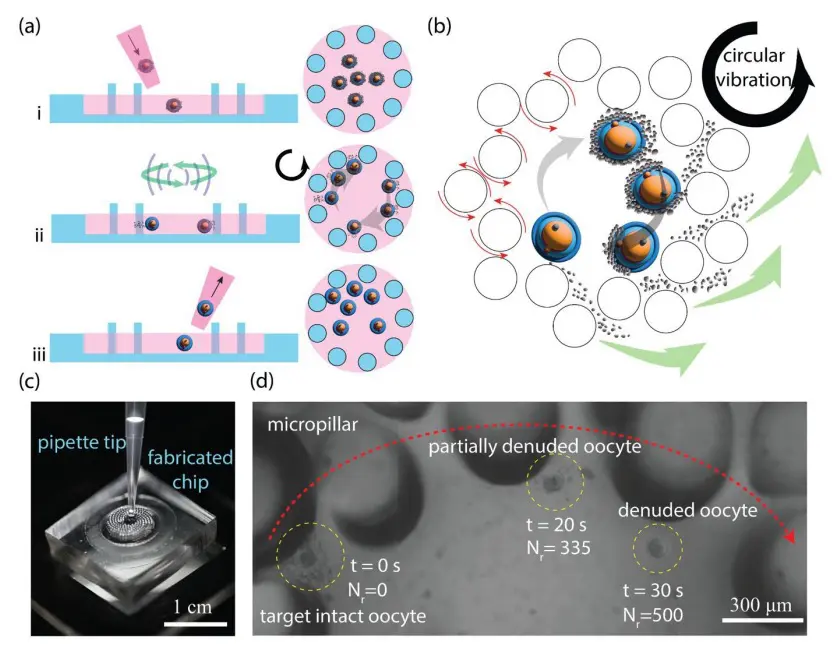
Figure 3. Approach for oocyte cumulus removal (CR) (a) Procedure of CR using VIF (i) loading (ii) CR (iii) cell extraction. (b) Oocyte denudation mechanism undergoing VIF. (c) Oocyte being loaded onto the chip. (d) Stacked images showing CR at different times (t).
The results showed that the open surface design made loading and collection easier. The shear force from the designed pillars on the chip was enough to break off cumulus cells during VIF. Since the micropillars’ pitch was larger than the cumulus cells but smaller than the oocyte, VIF removed the separated cumulus cells from the loading chamber. Cumulus cells were removed to the annulus, which was well designed on the chip, while denuded oocytes remained in the loading chamber area. This enabled the team to perform CR on up to 23 oocytes simultaneously, unlike the manual pipetting process that handles one at a time.
This study showcases the ease of use of the Moku:Go Waveform generator and the ability to quickly iterate experiments. It also demonstrates Moku’s ability to be used in many different areas of research. Amirhossein Favakeh, a PhD student in the Abbaspourrad Lab, credited the Moku for making the experimental set up much easier, “I have used many different function generators and Moku has made my workflow dramatically easier and more efficient.”
References
[1] Amirhossein Favakeh, Amir Mokhtare, Hanxue Zhang, Yi Athena Ren, Alireza Abbaspourrad; On-chip oocyte cumulus removal using vibration-induced flow. Lab Chip 2025; 25 (21): 5551–5562. https://doi.org/10.1039/d5lc00414d