


In optical and RF applications, microwave frequencies see a huge variety of uses, from carrying information themselves or being used to modulate optical beams. These applications require both frequency tunability and high spectral purity. Commercial microwave sources often must compromise between these two. By comparison, optical sources such as lasers have extremely low phase noise, and many attempts have been made to divide this optical purity down into the microwave domain. One such emerging technique is electro-optic frequency division (eOFD).
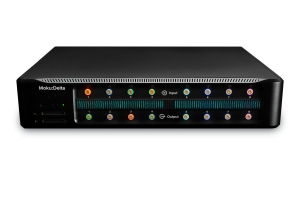
To assist with their novel eOFD scheme, researchers at IMRA America used Moku, an FPGA-based device from Liquid Instruments that delivers a reconfigurable suite of test and measurement instruments for fast, flexible signal processing and analysis. Leveraging the Laser Lock Box, the group could ensure that their eOFD setup remained stably locked to an atomic reference for extended periods of time. Their results were recently published in Nature Communications [1].
The challenge
Optical frequency division (OFD) attempts to take a low-noise source such as a laser, and transfer that spectral purity into the microwave domain through frequency division. It is a well-explored technique with several competing architectures. However, each of these methods has significant drawbacks, including difficulty with frequency tuning, or excessive noise. This leads to the same problem that OFD attempts to solve: microwave synthesis is still compromising between tunability and phase noise.
A promising OFD candidate, eOFD, uses a microwave source to drive an electro-optic modulator (EOM), which modulates an optical reference consisting of two tones. The use of the microwave source allows the user choice of frequency. In one particular, the eOFD signal is measured with a photodetector and the output is then used to provide feedback to the microwave source, disciplining it to the optical source. However, this feedback setup once again limits the tuning range and necessitates significant loop bandwidth. In IMRA’s case, they attempted a novel setup with feedforward noise cancellation instead of feedback.
The solution
As seen in Figure 1, the team implemented feedforward noise cancellation in their eOFD setup. First, a signal from a microwave source is split into two paths. In one path, it modulates two optical reference tones via an EOM, and then passes through an optical filter. This modulation effectively multiplies the microwave frequency into the optical domain, where it can be compared to the reference spacing (both of order ~300 GHz). With careful selection of multiplier, reference spacing, and filtering, the photodiode receives a single beat note containing the phase information of the optical references and microwave synthesizer. The result is then frequency divided by the same factor, bringing it back into the microwave domain. However, it still contains the original phase noise of the source.
The team then mixed the resulting beat signal with a phase-compensated version of the original microwave signal. This cancels out the phase noise of the original source, leaving only the noise of the laser source. This method retains the tunability of the microwave source, while compensating and canceling out its phase noise.
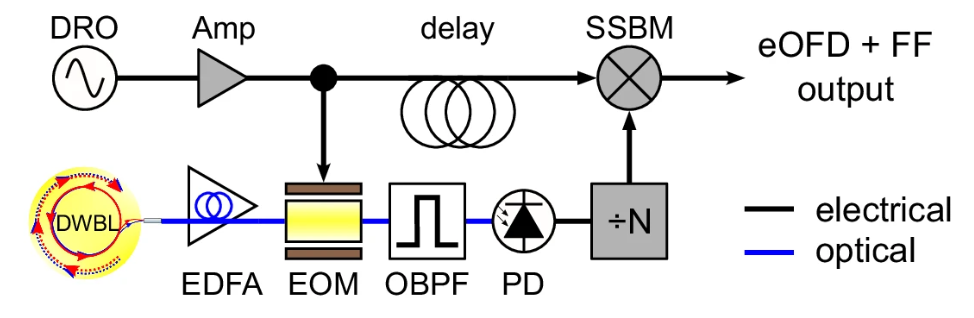
Figure 1. eOFD setup with a fixed-frequency microwave source, demonstrating feedforward noise cancellation. Reprinted from [1].
The result
In their published results, the team first tested their scheme on a fixed 10 GHz source, demonstrating extremely low phase noise. They then showed frequency tunability by using a commercially available microwave synthesizer in place of the fixed source. They measured over an octave ranging from 8 to 16 GHz. As a result, the source’s phase noise above 1 kHz offset was suppressed, lowering the phase noise floor to < -145 dBc/Hz at higher offsets. In this case, the delay compensation and multiplier were fixed, meaning no adjustments had to be made during tuning. However, it may be possible to lower the noise floor further by tuning the frequency divider and offset between the reference lasers for the desired frequency tone.
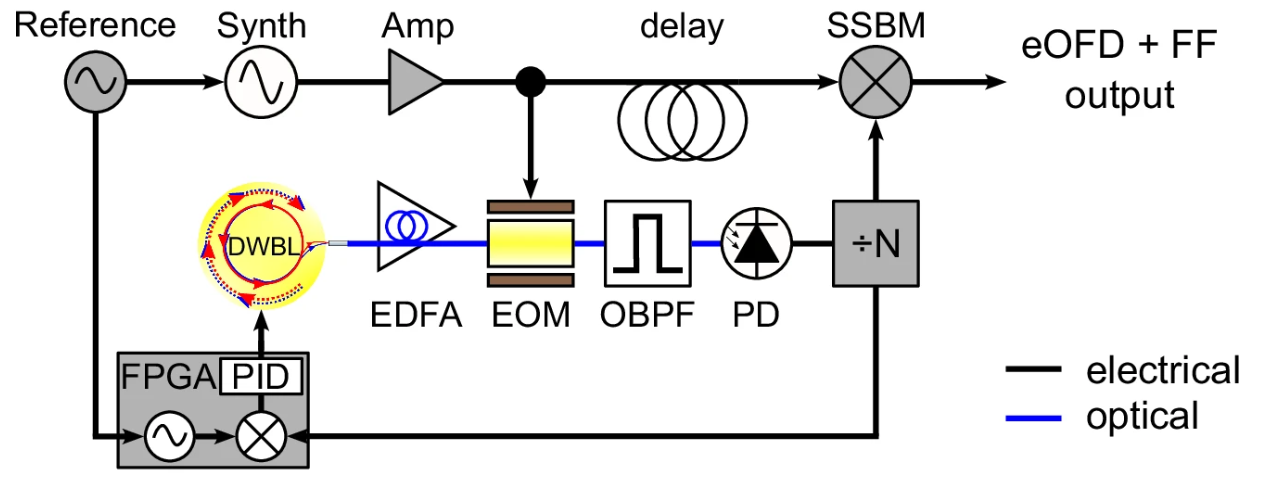
Figure 2. Phase-locked loop implementation, adding Moku Laser Lock Box and an atomic reference to the eOFD setup. Reprinted from [1].
Microwave synthesizers must not only have tunability and low noise, they must be stable over extended periods of time. Most commercially available microwave sources can be disciplined to an external 10 MHz reference, sourced from an ultra-stable source such as a rubidium atomic clock. The team took this approach, as seen in Figure 2. They implemented a feedback loop using the Moku Laser Lock Box, a software-defined laser locking module. The Laser Lock Box incorporates an internal oscillator which serves as a reference. The team fed the output of the frequency divider to the Laser Lock Box, where it mixes with the reference oscillator. The resulting error signal passes to the Laser Lock Box’s PID controller, which provides feedback to the laser. This phase-locked loop (PLL) controls the frequency spacing of the two optical sources, keeping them stable.
To ensure frequency stability over extended time periods, the group also added an atomic reference, which they fed to the microwave source as well as the Moku. As seen in Figure 3, implementing the phase locked loop and atomic reference resulted in improved frequency stability over the order of hundreds of seconds.
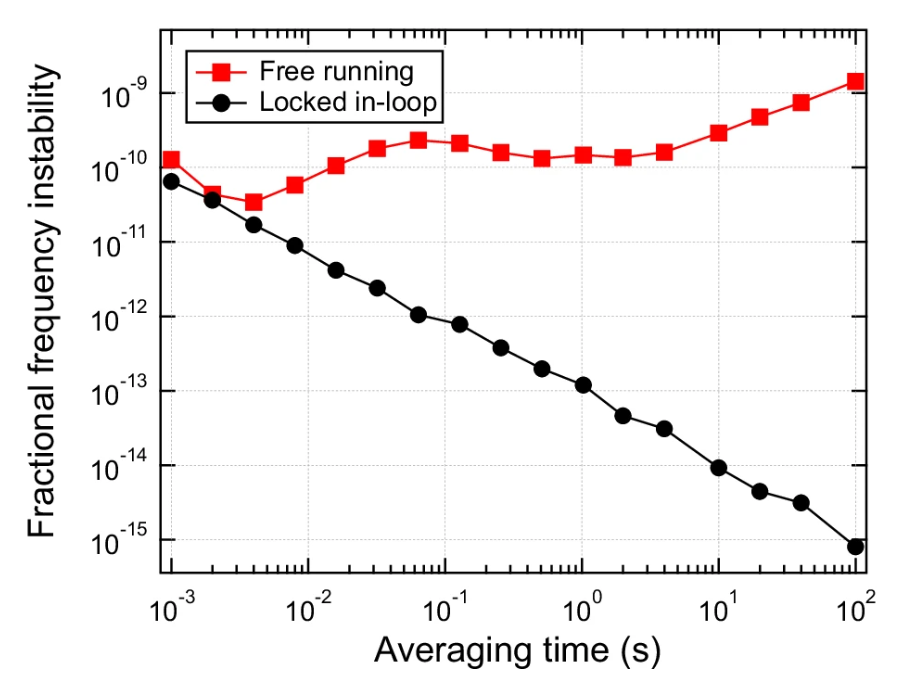
Figure 3. Residual frequency instability versus averaging time. After implementing the phase-locked loop with Moku and an atomic reference, the stability improved by several orders of magnitude. Reprinted from [1].
With the help of Moku, the team implemented a hybrid feedback/feedforward eOFD architecture that was tunable, low-noise, and stable over long periods of time. In the future, ultra-low jitter microwave sources may enable new applications in electronics.
References
[1] Greenberg, J., Egbert, S.C., McGrew, W.F. et al. Tunable microwave frequency synthesis with optically-derived spectral purity. Nat. Comm. 17, 8027 (2026). https://doi.org/10.1038/s41467-026-74912-1