


Quantum optics as a concept dates back to either 1900 or 1905, years when groundbreaking work in the realm of quantum mechanics was published by Max Planck and Albert Einstein, respectively. In Planck’s case, he was working on a discrepancy that later became artfully known as the “ultraviolet catastrophe.” Planck’s solution to this problem, in brief, was to assume that the energy of light was not a continuous spectrum — that it was instead organized into quanta. Einstein used this radical idea to explain another issue confounding physicists at the time, known as the photoelectric effect. His 1905 paper explaining this phenomenon was the first of his four annus mirabilis publications that year and earned him the 1921 Nobel Prize in Physics. These quanta that Maxwell proposed and Einstein described are known as photons, and they are a key component of the wave-particle duality of light, an observation that revolutionized existing physics and essentially invented the entire field of quantum mechanics. The branch of quantum optics (QO) later grew out of this early work, seeking to further understand the quantum nature of light, particularly light as it interacts with matter. Over 100 years later, QO has grown into an enormous field of research with many of its own sub-fields, and earning many Nobel Prizes for its researchers.
Sub-fields of quantum optics: from sensing to computation
Quantum optics has many sub-fields; some of the most prominent are described below. This is not an exhaustive list, as new discoveries are being made every day. Additionally, research within a sub-field does not always fit into neat boxes — overlap of subject matter and experimental techniques are common.
Quantum information science (QIS)
QIS involves the study of quantum computing, communication, and cryptography. These fields typically utilize quantum states for information processing and secure data transmission. This has arguably been the most prominent application of quantum optics of the past decade, as the 2022 Nobel Prize in Physics was awarded for work in the field of QIS. The last few years have also seen quantum computing transform from a niche academic topic into a large-scale industry. Even strictly staying within the bounds of optical quantum computing, many types of qubit systems are vying for supremacy, including trapped ions, neutral atoms, and photonic processors. Outside of computation, fields such as cryptography may see changes due to the promise of secure communications via quantum key distribution (QKD).
Quantum metrology
This field centers around the measurement of physical quantities using quantum properties such as superposition and entanglement, ultimately aiming for accuracy beyond classical limits. Applications include timekeeping with optical atomic clocks, quantum sensing, and quantum holographic imaging.
Cavity quantum electrodynamics (CQED)
CQED studies the interaction between quantized light and matter within a cavity. Optical cavities make excellent spaces to isolate and preserve single atoms (either artificial or natural) and photons, allowing us to investigate phenomena like quantum entanglement and coherence. Groundbreaking work in CQED earned the 2012 Nobel Prize in Physics. Although still an active field of research on its own, CQED techniques developed in the 1990s and 2000s played an integral part in the development of modern quantum computer architecture.
Quantum nonlinear optics (QNLO)
QNLO examines the interaction of light with matter in so-called nonlinear media, meaning a medium where the polarization responds non-linearly to an applied electric field. This usually can only be achieved at extremely high powers, a condition that modern lasers are able to meet. QNLO focuses on the effective interaction of individual photons with other photons in systems such as Rydberg atoms.
Ultrafast optics
This field deals with extremely short time-scale phenomena in quantum systems, typically on the order of 10-15 (femtosecond) to 10-18 (attosecond) scale. Pioneering work on the generation of ultrafast laser pulses recently won the 2023 Nobel Prize in Physics. The pulses can be used to probe and control the dynamics of atoms and electrons, which occur on incredibly short timescales. Ultrafast laser pulses mean that they are also intense in power, which means that they are particularly useful for generating nonlinear behavior in materials (see the section on QNLO above).
The building blocks of quantum optics experiments
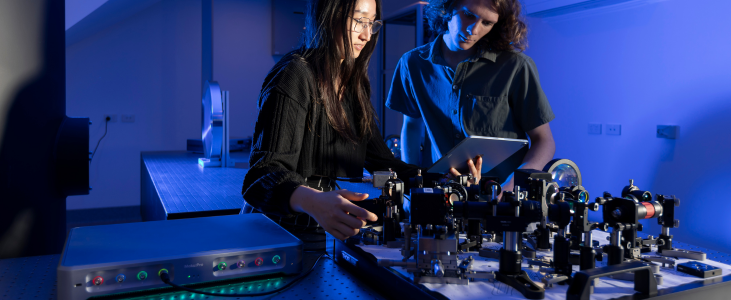
While the range of experiments performed in this field is vast, there are some pieces of equipment that are common throughout many quantum optics labs.
- Lasers. It is safe to say that quantum optics as a field would not exist without the laser. First proposed by Schawlow and Townes in 1958 and demonstrated by Maiman in 1960, lasers have become ubiquitous throughout physics, engineering, and chemistry research. The two main features of lasers are that they are monochromatic and coherent, meaning that they operate at a single frequency and that all of the emitted photons are in phase with each other. These properties allow researchers to target and drive specific atomic transitions, preserve quantum state information over long distances, and perform highly accurate interferometry.
- Acousto-optic and electro-optic modulators (AOM/EOM). While operating on different physical principles, these two devices are very similar in functionality, which is to modulate a laser beam. By applying an RF signal to the input of the modulator in conjunction with the beam, one can amplitude-modulate (AM) or polarization-modulate at a given frequency. Modulated signals are easily detected with a Lock-in Amplifier. The RF signal itself can be controlled by an Arbitrary Waveform Generator for advanced pulse shaping.
- Optical cavity or resonator. Many experiments on the quantum scale involve single-photon or single-atom physics. Thus, it is important that the interaction between light and matter be enhanced by the use of an optical cavity. Optical cavities typically consist of two opposing, highly polished mirrors and have a high quality factor, meaning that the light oscillates many times between the two mirrors before exiting the cavity. The frequency of laser beams are typically synchronized to the cavity resonance via a technique known as laser locking.
- Interferometers. These devices consist of an arrangement of beam-splitters and mirrors, and operate by splitting an incoming laser beam into two paths. One of these paths is used as a reference signal, while the other contains the system under test. After this, another beam splitter recombines the beams to create interference patterns, which are analyzed to measure small changes in displacement, rotation, or refractive index. Photodiodes and a Lock-in Amplifier are typically used to measure the output of an optical interferometer.
Future perspectives for quantum optics
Technology in quantum optics continues to improve, leading to increased sensitivity in timekeeping and measurement, as well as safer encryption of data. Optical quantum computing also promises to solve certain problems that are difficult on today’s computers. Ultrafast, high-power lasers can extract previously-unknown behavior from materials. To keep this field moving forward, precise and versatile test and measurement equipment must evolve with it. To learn more about how Moku software-defined instrumentation is propelling the development of quantum optics experiments, check out these case studies: Advancing optical clock performanceLearn how researchers at Humboldt University of Berlin and the Ferdinand-Braun-Institut are using a digital-first approach to eliminate tedious manual processes, automate essential tests, and optimize clock stability. Auto-aligning optical cavities with machine learningLearn how Floquet researchers are using software-defined instrumentation to automate laser beam alignment and advance machine learning capabilities to physical systems. Increasing precision in quantum metrology Learn how a team at Shanghai Jiao Tong University are pushing quantum metrological techniques to their limit using digital lock-in detection and spectrum analysis. To discover how to get started implementing a phase-locked loop (PLL) with the Moku Lock-in Amplifier, check out our quick-start guide.
Questions?
Get answers to FAQs in our Knowledge Base
If you have a question about a device feature or instrument function, check out our extensive Knowledge Base to find the answers you’re looking for. You can also quickly see popular articles and refine your search by product or topic.
Join our User Forum to stay connected
Want to request a new feature? Have a support tip to share? From use case examples to new feature announcements and more, the User Forum is your one-stop shop for product updates, as well as connection to Liquid Instruments and our global user community.