

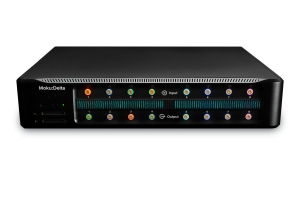
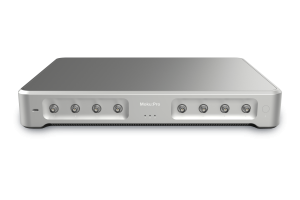


We often use the expression “like finding a needle in a haystack” when describing an exceptionally difficult search. Suppose, though, that you had no idea what the needle looked like, or how big it was — perhaps it could be a thousand times smaller than you expect! In that case, your task might be approaching the difficulty of those being attempted in the realm of dark matter research. Although the presence of dark matter (and dark energy) are required to explain the current state of the universe, almost nothing is known about it, even its most basic properties. Scientists have thus undertaken many avenues of research in the attempt to comprehend dark matter. One of these projects, known as “Search for Particles of Light Dark Matter with Narrow-gap Semiconductors,” or “SPLENDOR” for short, is a collaboration between scientists at the SLAC National Accelerator Laboratory, Los Alamos National Laboratory (LANL), CSU East Bay, the University of Illinois Urbana-Champaign, and Santa Clara University1.In their search, the researchers are using Moku:Pro, an FPGA-based test and measurement device that delivers more than 15 software-defined instruments. Leveraging the Data Logger instrument and Moku Python API, the team has created extremely sensitive DM detectors, enabling them to search for dark matter (DM) in an unexpected place — at energy scales far below the range of most typical detectors.
The challenge
In physics, the sizes of elementary particles are usually described not in units of mass, but rather in energy — specifically, the electron-volt (eV). These two quantities are related by Einstein’s famous mass-energy equivalence equation. For example, the rest mass of an electron is about 511 keV. Typical dark matter experiments search for theorized particles such as WIMPs and axions the range of energies from MeV to GeV, or sometimes even higher. SPLENDOR, on the other hand, is turning their attention to energy scales below 1 MeV, hence the term “light” dark matter. To perform experiments in this range, however, requires flexible new dark matter detectors. Given the low energy of the proposed dark matter particles, extremely sensitive detectors are required. In this regard, SPLENDOR leverages LANL’s rich materials science history to create novel semiconductor devices with bandgaps in the range of 1 to 100 meV, sensitive enough to detect light DM events. When a dark matter particle collides with the material in the semiconductor, it produces a small current response. These events occur at random times, however, and the current responses can be easily lost in the noise of room temperature electronics.
The solution
In order to record these incredibly low-energy events accurately, the team cools the detector package (see Fig. 1) to 0.01 K using a commercial dilution refrigerator. This setup minimizes electrical noise, providing a clean environment in which to monitor events in realtime.
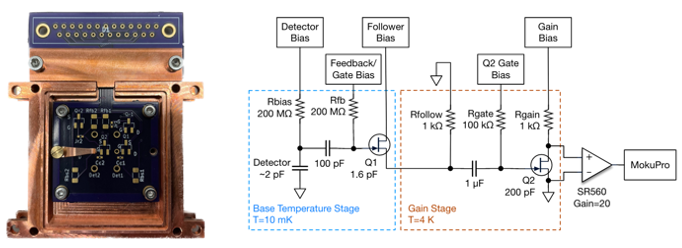
Figure 1. Light dark matter detection scheme. Left: photo of the semiconductor-based dark matter detector mounted in its compact cryogenic housing. Photo courtesy of Los Alamos National Laboratory. Right: schematic of the measurement chain from 10 mK to room temperature. Reproduced from the preprint2.Within the cryostat, the SPLENDOR team has also devised a clever two-HEMT scheme that amplifies the event current signal at different temperature stages (Fig. 1). This approach allows the signal to be safely retrieved from the dilution fridge and recorded at room temperature. By measuring the input noise of the system in absence of a detector, the team has reported an expected resolution of approximately 7e, or seven times the charge of an individual electron. Even with this, though, dark matter particles do not always appear at times that are convenient for researchers. Searching for light DM events requires them to constantly monitor the system, which the team achieves with the Data Logger. As seen in Figure 2, an output line from the cryostat is connected to an Input channel of Moku:Pro.
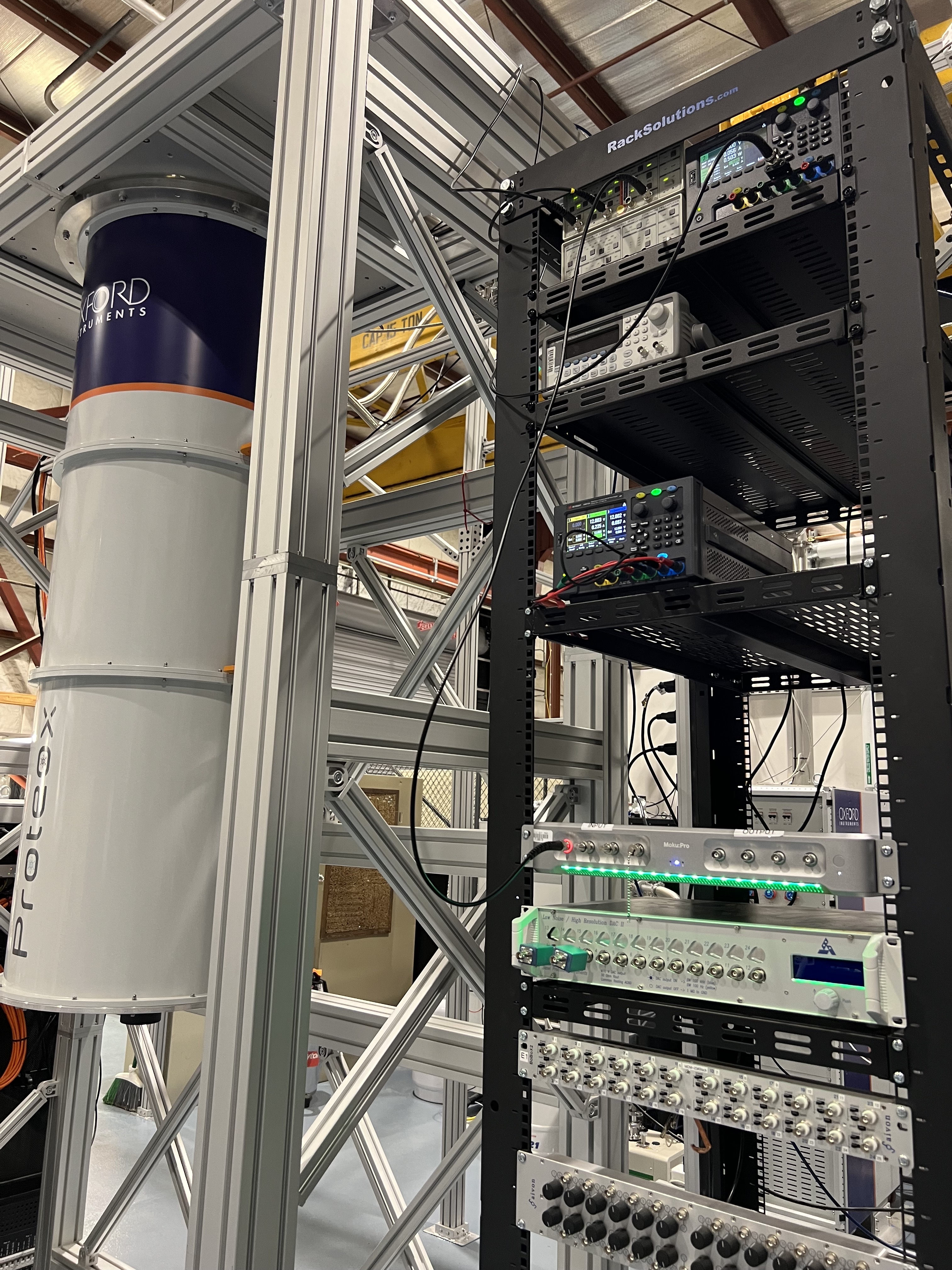
Figure 2: SPLENDOR experimental setup at SLAC. A rack-mounted Moku:Pro is ready to detect events from the detector, located in the Oxford Proteox dilution refrigerator shown. Photo courtesy of SLAC National Accelerator Lab. When the researchers are ready to scan for dark matter events, the Data Logger is configured to continuously monitor the system for windows of 1 minute or more. The voltage at the Moku:Pro Input is recorded as a function of time, with sharp, exponentially rising peaks representing an “event.” Some of these events, however, are low-amplitude and cannot be detected easily with the naked eye — post-processing of the data is required for them to appear. Fortunately, data files can be easily converted from the native .li format to .csv, .npy, or .hdf5 using the built-in Moku:Pro file converter, allowing them to be imported to Python for further analysis. To learn more about how the data collected by SPLENDOR is handled and processed, read our blog post on SPLENDAQ, the open-source data analysis tool developed by LANL researcher Dr. Samuel Watkins. Dr. Watkins, who began using Moku:Pro when he joined the project, says that the Data Logger compares favorably to using a custom data acquisition (DAQ) system.“We’re shaving off tons of development time in creating some type of homemade DAQ, when generalized systems like Moku already exist,” he said. “We also almost always use the Moku app’s GUI first, so we can easily see live data when we’re changing various settings. Creating a GUI ourselves would be an intensive programming task.”
The result
It is still unknown exactly which detector composition is the most efficient for capturing light dark matter events. But with their new measurement tools in place, the SPLENDOR team can rapidly iterate through many new detector designs and semiconductor combinations, with the goal of increasing the sensitivity even further and allowing the secrets of dark matter to be explored — no matter the size of the “needle” they’re searching for in the proverbial haystack. Dr. Watkins sees a role for the standardization of Moku:Pro and its software in this endeavor. “I definitely think Moku helps with the goal of having generalized open-source software available in our field on the data acquisition side,” he said. “We have collaborators who use a Moku:Go and the SPLENDAQ package for event building, and without the open-source nature of the Moku APIs, I would not have been able to set them up with the system in one trip to their lab.”For more information, read the preprint on the arXiv2.
Questions?
Get answers to FAQs in our Knowledge Base
If you have a question about a device feature or instrument function, check out our extensive Knowledge Base to find the answers you’re looking for. You can also quickly see popular articles and refine your search by product or topic.
Join our User Forum to stay connected
Want to request a new feature? Have a support tip to share? From use case examples to new feature announcements and more, the User Forum is your one-stop shop for product updates, as well as connection to Liquid Instruments and our global user community.
Footnotes
[1] Report number LA-UR-24-20436[2] J. Anczarski et al. Two-stage cryogenic HEMT based amplifier for low temperature detectors. arXiv:2311.02229 [physics.ins-det], 2023.