


This recap and Q+A complement our webinar, Digital feedback control loops in the frequency domain, which we co-hosted with EE World Online on May 8, 2025. If you weren’t able to attend live, register now for on-demand access. In addition to a webinar summary, detailed answers to select audience questions are covered below.
Webinar recap
This webinar explored how essential tools like feedback and control systems are applied across research and industry to simplify complex systems and enhance stability and responsiveness. The session covered core concepts of frequency-domain control loop theory, including transfer functions, frequency response, and stability analysis, along with methods for evaluating system behavior in reference tracking and disturbance rejection. A live demonstration of the digital Moku PID Controller highlighted how software-defined instrumentation enables rapid iteration and efficient system tuning.
Questions from the audience
Does Moku accept digital interfaces as feedback signals, like serial protocols, and quadrature signals?
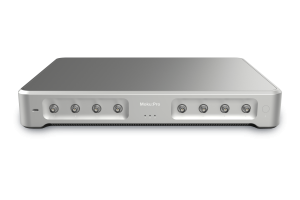
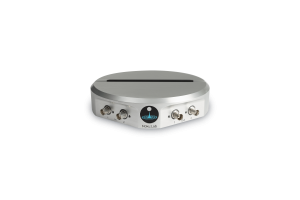
Since Moku:Pro and Moku:Lab lack digital I/O ports, all input signals must first pass through the analog frontend and be digitized by the ADC. Once digitized, instruments like the Moku PID Controller can use these signals. However, the PID Controller cannot directly interpret serial protocols. In such cases, it may be used alongside the Moku Logic Analyzer / Pattern Generator, which can decode or synthesize serial data streams. For quadrature signals, consider using the Moku Time & Frequency Analyzer to measure the phase or time delay between two channels, which can also generate an analog output proportional to the measured time interval.
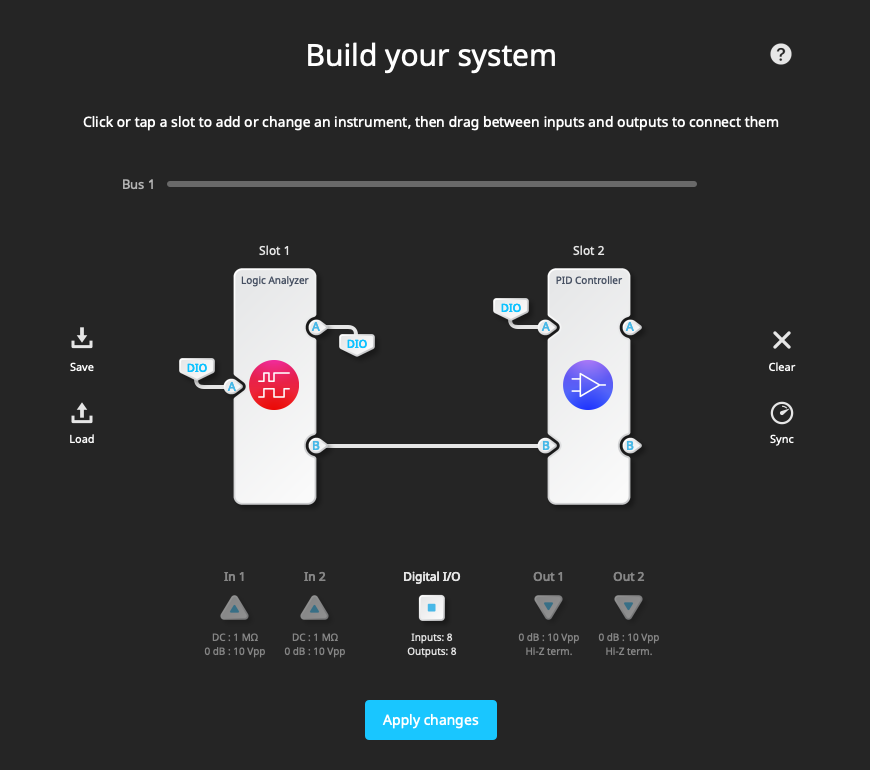
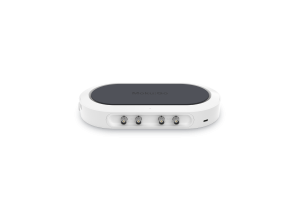
Figure 1. In Multi-Instrument Mode, the Moku:Go digital I/O port can be used in the same manner as the analog ports.Moku:Go, by contrast, features a 16-bit configurable digital I/O, as seen in Fig. 1. These pins can be arbitrarily set as inputs or outputs, allowing instruments to directly access digital signals. However, the same limitations apply: direct decoding of complex protocols must still be handled by the appropriate instrument.
Since your feedback system is software-controlled, it must be operating on a digital clock. What is the sampling or update rate of your control loop? What limits might there be on your loop bandwidth due to Nyquist constraints?
Yes, digital control systems are indeed bounded by sampling rate-derived constraints. In the Moku:Pro PID Controller, the internal DSP operates with a sampling rate of 78 MSa/s, from which the effective open-loop bandwidth of ~38 MHz is derived. In closed-loop configurations where ADCs and DACs are included in the signal path, the practical feedback bandwidth for Moku:Pro is specified as ~150 kHz. This value is governed primarily by conversion latency and phase delay, rather than Nyquist constraints alone.
During the demo, when you added an additional integrator you were not concerned by stability, because the gain was far above unity where the phase approached –180°. Why is this not a problem?
It is true that adding an integrator does increase the phase lag, which brings the system closer to the –180° phase shift associated with instability. However, the system was also operating with a large gain margin, meaning the overall gain of the system at those frequencies was still far above unity. Stability concerns arise when the open-loop transfer function approaches the critical point of –1 as represented in the complex plane, in other words a gain of 1 (0 dB) and a phase of –180°. This is the condition under which positive feedback can occur, leading to oscillations or instability. In the case of the demo, because the gain was still much greater than 1 at the point where the phase approached –180°, the system remained far from that critical point.
More questions?
Get answers to FAQs in our Knowledge Base
If you have a question about a device feature or instrument function, check out our extensive Knowledge Base to find the answers you’re looking for. You can also quickly see popular articles and refine your search by product or topic.
Join our User Forum to stay connected
Want to request a new feature? Have a support tip to share? From use case examples to new feature announcements and more, the User Forum is your one-stop shop for product updates, as well as connection to Liquid Instruments and our global user community.