

Please update your browser. For the best Liquid Instruments experience, update to the latest version of Chrome, Edge, Firefox, or Safari. Update Microsoft Edge.
Liquid Instruments Logo
Products
Hardware Platforms
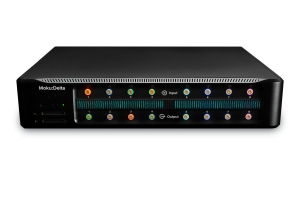
Moku:Delta
Moku:Delta
New
For advanced design and validation
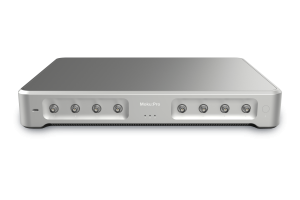
Moku:Pro
Moku:ProFor versatile test and measurement
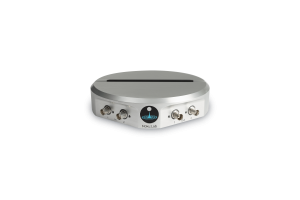
Moku:Lab
Moku:LabFor experimental research labs
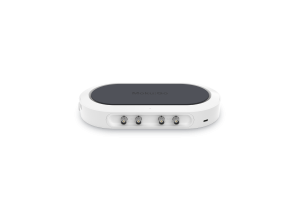
Moku:Go
Moku:GoFor quick testing and debugging
Compare Hardware
Compare HardwareView a side-by-side of all Moku hardware
Technologies
GenInst Studio
New
Generate personalized instruments
Integrated InstrumentsProfessional-grade instruments at your fingertips
Neural NetworkFPGA-powered neural network integration
Multi-Instrument ModeCombine instruments to create a customized test system
Moku CompileCode, compile, and deploy to your Moku's FPGA
Software
MokuOSDownload the Moku app for Windows, macOS, iPadOS & visionOS
APIsPython, MATLAB, LabVIEW
UtilitiesCommand line and graphical tools for file conversion
Instruments
Analysis
Oscilloscope
Spectrum Analyzer
Frequency Response Analyzer
Lock-in Amplifier
Phasemeter
Logic Analyzer / Pattern Generator
Time & Frequency Analyzer
Data Logger
Generation
Waveform Generator
Arbitrary Waveform Generator
Control & Conditioning
PID Controller
Digital Filter Box
FIR Filter Builder
Laser Lock Box
Custom & Utility
GenInst Studio
New
Gigabit Streamer
Custom Instrument
Neural Network
Multi-Instrument Mode
Applications
Optics and Photonics
Microscopy and Spectroscopy
Photon Counting
Quantum Optics
Aerospace and defense
A&D Instrumentation
Component Test
Automated Testing
Semiconductor Test
Control Systems and Bode Analysis
MEMS Testing
AI and Machine Learning
Generative Instrumentation
New
Neural Networks
Education
Education and Research
Resources
App Notes
Blog
Case Studies
Coursework
Guides
Product Documentation
Publications
Webinars
White Papers
Support
Company
Contact Us
About Us
Leadership
Partners
News & Updates
Press
Events Calendar
Careers
Store
Moku:Delta
Moku:Pro
Moku:Go
Upgrade Moku:Pro
Upgrade Moku:Lab
Upgrade Moku:Go
0
Get a quote Buy Now
Build personalized instruments with GenInst Studio in minutes, not months. | Register for the webinar
Case studies • April 27, 2022

Advancing the search for dark matter with Moku:Lab

University of Alberta researchers use the Moku:Lab Lock-in Amplifier to aid in attempts at dark matter detection


    University of Alberta logo

    Introduction

    At the University of Alberta, researchers are working to develop ultra-sensitive devices to improve dark matter detector technologies. This requires high-precision measurements, initially as a prototype in the lab and ultimately as an online monitoring system to be installed at 2km underground. Moku:Lab’s compact form factor and versatility enable researchers to perform experiments in a variety of environments to determine the sensitivity of detectors to dark matter.

    The challenge

    Dark matter is estimated to account for over 80% of the mass in our universe, but remains one of the biggest mysteries in physics. While its existence has been inferred by its gravitational effect on ordinary matter, scientists are hard at work developing detector technologies in hopes of observing dark matter particles. In collaboration with the NEWS-G (New Experiments with Spheres – Gas) experiment, Dr. Marie-Cecile Piro, Assistant Professor of Physics at University of Alberta, and her group are working with detectors called spherical proportional counters, which contain neon and methane gas.
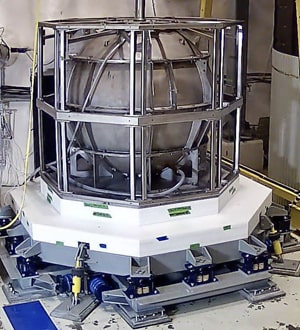
    Figure 1: The NEWS-G experiment’s dark matter detector during installation at SNOLAB, 2km underground (image from NEWS-G collaboration).

    Figure 1: The NEWS-G experiment’s dark matter detector during installation at SNOLAB, 2km underground (image from NEWS-G collaboration).

    The probability of dark matter interacting with the detector is directly related to the amount of methane in the detector. “The amount of methane impacts the sensitivity of the detector – even a 1% difference would be huge – so we need very high-precision measurements,” said Dr. Piro. “We are currently developing with my M.Sc. student, Carter Garrah, a laser spectroscopy technique for ppb-level detection of methane to be able to extract our sensitivity to dark matter when analyzing the physics data.”

    While initial development and characterization of the prototype measurement system will be done in the Piro lab, ultimately it will be deployed with the main detector which is located 2km underground to shield experiments from cosmic rays. Live, ongoing monitoring of methane concentrations in the detector will be essential to ensure the active target properties of the detector over time.

    Learn more about the applications of Moku:Pro

    The solution

    Researchers at the University of Alberta selected Moku:Lab based on its combination of measurement performance, flexibility, and compact design. Moku:Lab’s Lock-in Amplifier allows them to detect very small signals to accurately measure methane levels in the detector. The built-in oscilloscope provides visualization of the signal at different points in the signal processing chain to troubleshoot or optimize the experiment. “This is really helpful during commissioning, for example, to understand any issues and determine what settings you need,” said Dr. Piro.
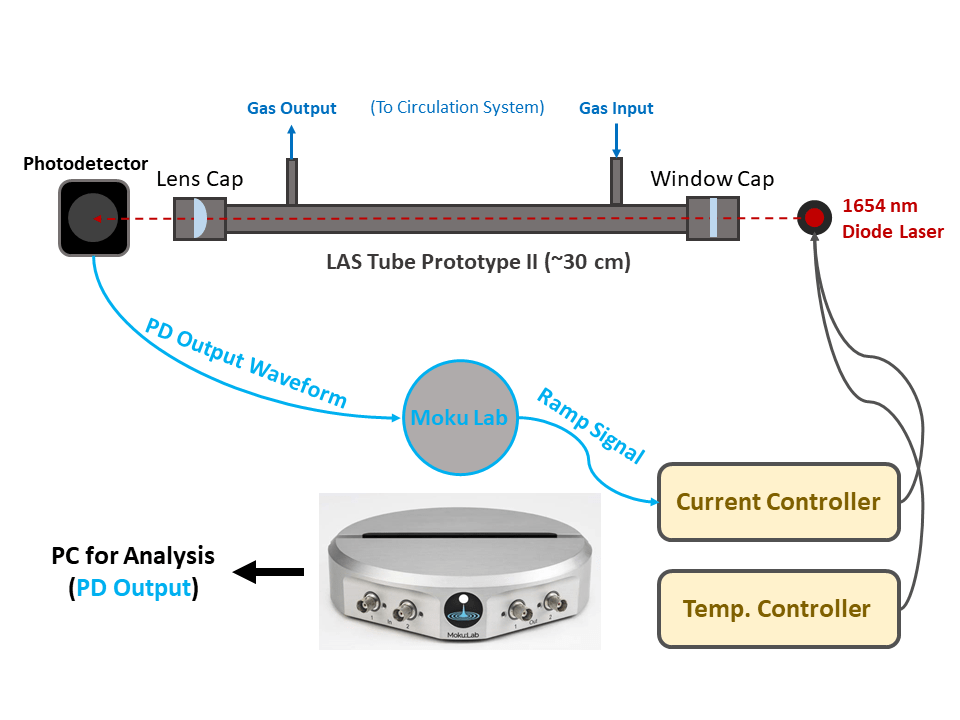
    Figure 2: Block diagram of the prototype laser spectroscopy measurement system. The gas from the detector circulates through the LAS tube and where laser spectroscopy is used to detect the methane concentration. Moku:Lab detects the photodiode output signal and generates an error signal to drive the diode laser (image from Carter Garrah).

    Figure 2: Block diagram of the prototype laser spectroscopy measurement system. The gas from the detector circulates through the LAS tube and where laser spectroscopy is used to detect the methane concentration. Moku:Lab detects the photodiode output signal and generates an error signal to drive the diode laser (image from Carter Garrah).

    Moku:Lab’s compact form-factor makes it easy to work with in the lab and ensures they will be able to deploy it to monitor the main detector when the system is ready. Using the iPad wireless display allows them to move around the lab while controlling the measurements. Access to the additional integrated instruments will also prove useful as they explore other aspects of this and related projects.

    Figure 3: Laser spectroscopy measurement system prototype physical setup shown in the lab (image from Carter Garrah).

    Figure 3: Laser spectroscopy measurement system prototype physical setup shown in the lab (image from Carter Garrah).

    The result

    In the search for dark matter, many mysteries remain. With so many unknowns, equipping a lab can be difficult, but Dr. Piro and team are looking forward to exploring the possibilities with Moku:Lab. “Having Moku:Lab will be an asset for analyzing the signals and monitoring gas concentration, but I’m sure we will find other applications as well,” she said. Moku:Lab’s high-precision Lock-in Amplifier is an essential piece of equipment to determine the NEWS-G detector’s sensitivity to dark matter as they endeavor to understand more about the universe.


    Learn more about the applications of Moku:Pro

    Have questions or want a printable version?

    Please contact us at support@liquidinstruments.com

    Try Moku in demo mode Download the Moku app → Get answers to FAQs Visit Knowledge Base → Connect with Moku users Join the user forum →

    Other Recommended Case studies

    Case studies
    Phase Stabilization for Quantum Key Distribution with Moku:Pro

    Learn how researchers at the University of Hamburg are using Moku to improve signal fidelity for continuous-variable QKD.

    Featuring: Moku:Pro, PID Controller, Lock-in Amplifier, Laser Lock Box

    Date: Mar 16, 2026

    Case studies
    Enabling Dual-Wavelength Nanosecond Fiber Lasers for Multi-Contrast Photoacoustic Imaging with Moku:Pro

    Learn how researchers at the University of Hong Kong used Moku:Pro to generate synchronized shortwave-infrared nanosecond pulses and stabilize modulation depth for dual-wavelength photoacoustic imaging.

    Featuring: Moku:Pro, Waveform Generator, PID Controller

    Date: Dec-19-2025

    Case studies
    Teaching lock-in detection with Moku:Go

    Learn how students at IIT Madras are gaining hands-on experience in using the Lock-in Amplifier instrument on Moku:Go

    Featuring: Moku:Go, Lock-in Amplifier

    Date: Dec-15-2025

    Back to all Case studies

    Nav

    • Products
    • Instruments
    • Resources
    • Support
    • Company
    • Contact Us
    • Privacy Policy
    • Terms of Use

    Offices

    United States
    (619) 332-6230
    12526 High Bluff Dr.
    Suite 150
    San Diego, CA 92130

    Australia
    +61 2 6171 9730
    243 Northbourne Avenue
    Suite 1, Level 1
    Lyneham, ACT 2602

    Australia
    +61 3 7073 3594
    Suite 5C, Level 5,
    700 Swanston Street,
    Carlton, VIC – 3058


    Follow us

    LinkedIn YouTube X Facebook Instagram

    官方微信

    © 2026 Liquid Instruments. All rights reserved.