


Approximately one half of the radiant energy emitted by the universe, be it from protostars in our own galaxy, or ultra-luminous galaxies in the local universe, is detected in the far-infrared spectral range (30 to 1000 µm) [1]. Spectrometers designed for this spectral range must operate at cryogenic temperatures (<1 K) and often include moving parts which require actuation and sensing. Previous cryogenic far-infrared space astronomy missions have employed several metrology techniques such as capacitance micrometry, inductive sensing and optical encoding. A laser-based metrology system, however, offers several advantages for cryogenic deployment, among the most important being inherent precision of the technique, ease of integration, low power required and range of application.
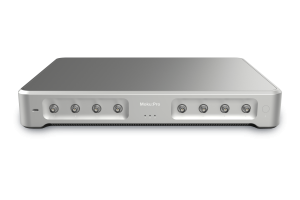
Blue Sky Spectroscopy Inc. (Blue Sky) has developed a multi-axis implementation of the technique of sinusoidal frequency modulation (SFM) which allows the displacement along 8 independent axes to be measured using only a single laser and detector [2]. Uncertainties in displacement depend on the stability of the probing laser. Fortunately, there are some well-known methods available that researchers can use to stabilize their lasers, such as the Pound-Drever-Hall (PDH) technique. However, what if the laser wasn’t located in a typical lab environment, but rather performing far-infrared spectroscopy in space, with no one to maintain it? A research team at Blue Sky is working on the answer. In a recent publication, they outlined the development of a novel laser locking technique for their SFM interferometer. To expedite their research development, the team used Moku:Pro, an FPGA-based device that delivers a reconfigurable suite of test and measurement instruments.
Specifically, the team leveraged the Moku PID Controller and Moku:Cloud Compile — a tool available on all Moku devices that allows users to quickly deploy custom functionality — to analyze the SFM results and provide real time feedback to the laser. Using this approach, they substantially improved the stability of their laser, making it a beneficial technique for the laser displacement metrology system proposed for the NASA PRIMA probe mission, which aims to deploy a cryogenically cooled, far-infrared spectrometer in space.
The challenge
Laser interferometry is a common technique for measuring displacement. Using two beam paths, with one acting as a reference of known length, one is able to extract information about the other, unknown path based on the resulting interference pattern. In the SFM technique used by the Blue Sky team, the frequency of the laser is modulated such that it oscillates around a central carrier frequency (i.e., the plot of laser frequency vs. time resembles a sine wave). To resolve small changes in optical path distance (OPD) accurately, it is critical that the carrier frequency of the laser be ultra-stable. The range of modulation frequencies should also be relatively large. For example, to measure an OPD of < 1 m, the modulation range should be > 2 GHz. This large modulation range makes locking the laser difficult.
The Pound-Drever-Hall (PDH) locking technique which uses an external cavity, is frequently used in laboratory applications. However, this technique works best when the modulation range is small and contained entirely within the linewidth of the cavity. Moreover, these high-finesse cavities are not only expensive, but require special vacuum housing and controlled temperature environments. The traditional PDH technique was considered unsuitable for a cryogenic space-based deployment, so the team explored alternate methods.
The solution
The Blue Sky team proposed two improvements to the locking technique specifically adapted to the harsh environment of space. Firstly, they replaced the external cavity with a gas cell containing hydrogen cyanide (HCN) at low pressure having an absorption line at a known reference frequency. While this approach reduces both the maintenance requirements and associated costs, the issue of the small linewidth of the absorption line remained. To this end, the team developed a novel locking mechanism using Moku Cloud Compile to generate an error signal.
The schematic is outlined in Figure 1a. The 1550 nm laser generates the carrier frequency, with the sinusoidal frequency modulation provided by a separate FPGA. The beam passes through an optical circulator and into a 20 dB directional coupler. Most of the laser power exiting the coupler is directed toward the displacement measurement (with the associated change in OPD represented by ΔΛ), however, a small portion passes through the HCN cell.
The signal generated by the frequency modulated laser passing through the gas cell, is digitized by the detector and sent to the Moku:Pro. The Blue Sky team used the Moku Cloud Compile feature to run their own custom procedure to generate the error signal. The purpose of this signal processing step is to take the digitized signal from the detector and turn it into an error signal that is fed to the PID controller. To this end the derivative of the detected signal is first computed, which produces zero crossings when the laser frequency passes through the center of the HCN absorption line. Subsequently, the duty cycle of these zero crossings is computed based on the amount of time the signal spends on either side of the line. The deviation of the duty cycle from the nominal value of 50% forms the basis of the error signal, which is then passed to the Moku PID Controller to form an active feedback loop. This method of calculating the error signal allowed the team to frequency modulate the carrier over a wide range of 3 GHz while keeping the laser tightly locked to the gas cell reference having a linewidth of only 0.2 GHz.

Figure 1: Experimental setup. (a) Laser locking system, featuring a gas cell reference and a multi-step analysis procedure using Moku Cloud Compile. (b) Multi-Instrument Mode setup, featuring the Moku Oscilloscope for debugging, as well as the Moku Digital Filter Box for prefiltering the error signal.
FPGA programming is normally a complex and time-consuming task, but Moku Cloud Compile streamlines the process of writing and deploying custom code on Moku hardware. Dr. Christiansen of Blue Sky credits the rapid prototyping process of Moku Cloud Compile for assisting him with his signal processing and analysis. “I recommended a Moku:Pro specifically for this project,” Dr. Christiansen said. “Other equipment wasn’t made with the needs of 2025 in mind.”
“Instead of having to do boilerplate code myself, it just runs,” he said. “Moku:Pro allows us to test out new ideas with ease to explore calibration strategies that will eventually be integrated into our own FPGA platform.”
While Moku Cloud Compile and the Moku PID Controller formed the backbone of the experiment’s feedback loop, the group also used debugging tools such as the Moku Oscilloscope, as well as the Moku Digital Filter Box for prefiltering the signal. The team’s Multi-Instrument Mode configuration is shown in Figure 1b.
The result
With their improved feedback loop in place, the team sought to evaluate their laser locking method using a 1312.6 nm HF frequency stabilized laser verification system (HFV) as the reference. With the HFV in place, the team could systematically evaluate the accuracy of the free running and unlocked interferometer by calculating the difference in measured displacement compared to the HFV system. They found that the relative error decreased from ~3 ppm in the free running case down to 0.04 ppm in the locked case, approximately the same level of uncertainty as the refractive index of the atmosphere [3].
Having improved the accuracy of their interferometer by two orders of magnitude, Blue Sky is actively working to commercialize their system and hopes to see it adopted for use on future spaceborne probes, including the NASA PRIMA mission, which seeks to develop far-infrared spectroscopy technology for investigating topics ranging from galaxy formation to the composition of planets and their atmospheres [4].
Dr. Christiansen reflects, “As a result of this project the Moku:Pro has become my preferred test and measurement tool.”
Questions?
Get answers to FAQs in our Knowledge Base
If you have a question about a device feature or instrument function, check out our extensive Knowledge Base to find the answers you’re looking for. You can also quickly see popular articles and refine your search by product or topic.
Join our User Forum to stay connected
Want to request a new feature? Have a support tip to share? From use case examples to new feature announcements and more, the User Forum is your one-stop shop for product updates, as well as connection to Liquid Instruments and our global user community.
References
[1] Hauser, M. G. and Dwek, E., “The Cosmic Infrared Background: Measurements and Implications”, Annual Review of Astronomy and Astrophysics 39(1), 249307 (2001).
[2] A. Christiansen, D. Naylor, and B. Gom. “Multiaxis applications of a cryogenic range-resolved laser interferometer”. In: Photonic Instrumentation Engineering X, 12428:124280Z, (2023). doi:10.1117/12.2647283.
[3] A. J. Christiansen, D. A. Naylor, M. A. Buchan, and B. G. Gom. “A novel laser frequency stabilization technique for FMCW systems.” In: Proc. SPIE 13373, Photonic Instrumentation Engineering XII, 133730C. (2025). doi:10.1117/12.3040732.
[4] California Institute of Technology. https://prima.ipac.caltech.edu/.
Acknowledgements
This program or project or activity is undertaken with the financial support of the Canadian Space Agency.