



Photoacoustic microscopy (PAM) combines the high contrast of optical imaging with the penetration depth of ultrasound, making it a powerful tool for non-destructive, label-free imaging of biological tissues and materials [1]. Achieving multi-contrast PAM, where multiple laser wavelengths probe distinct molecular bonds, requires a light source that can switch rapidly between wavelengths while maintaining high pulse energy and temporal precision. Yet, most tunable or Ramn-based laser systems are constrained by slow switching speeds, limited stability from sampling drifting, and complex free-space alignment. In particular, generating nanosecond-scale pulses in the shortwave infrared (NIR-III) region has proven especially difficult due to the absence of suitable pump sources and the fixed nature of Raman frequency shifts.
To overcome these limitations, Dr. Yitian Tong and his team at University of Hong Kong and Advanced Biomedical Instrumentation Centre recently demonstrated a dual-wavelength switchable all-fiber laser that delivers nanosecond optical pulses at 1725 nm and 1930 nm, corresponding to vibrational absorption peaks of C-H and O-H bonds [2]. The team implemented precise electro-optic modulation of two seed lasers to generate synchronized nanosecond pulse trains, enabling rapid electronic switching between the two wavelengths at up to 100 kHz.
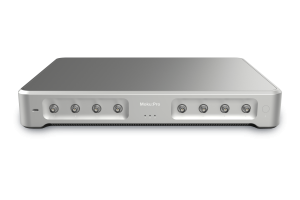
To realize this programmable modulation scheme, the researchers employed Moku:Pro as the flexible electrical pulse-shaping and stabilization platform for the electro-optic modulators (EOMs). The Moku:Pro Waveform Generator produced the high-fidelity nanosecond drive signals with tunable timing and amplitude, and the PID Controller maintained stable modulation depth throughout extended operation. This capability opened the door to rapid, high-resolution multi-contrast PAM imaging, demonstrated through the differentiation of microplastic types in water. This method showcases how adaptable electronic control can enhance fiber-laser photonics and environmental sensing.
The challenge
Generating nanosecond optical pulses for advanced PAM requires precise electronic control of EOMs. In this study, the research team needed to intensity-modulate the two continuous-wave seed lasers to produce synchronized nanosecond pulses at 1725 nm and 1930 nm. To achieve this, the electrical drive signals had to meet three strict criteria: high timing precision, adjustable modulation depth, and long-term stability.
Traditionally, building such an EOM drive system would demand multiple standalone instruments, including a high-speed pulse or arbitrary waveform generator for nanosecond drive signals, a separate DC bias controller to maintain the modulator’s operating point, a photodiode readout module for feedback, and a custom analog circuit to implement PID stabilization. Each device introduces latency, calibration overhead, and synchronization challenges. Moreover, maintaining modulation depth over hours of operation is difficult due to the temperature-induced drift and photo-refractive effects in the EOM, which can shift the bias point and degrade the optical extinction ratio. Without active compensation, the pulse energy and spectral balance between the two wavelengths would quickly destabilize, undermining reliable laser performance.
The team, therefore, required a single, programmable platform that could generate, synchronize, monitor, and stabilize the EOM drive signals with deterministic timing, which capabilities would otherwise span multiple specialized instruments.
The solution
The researchers deployed Moku:Pro as the unified engine for pulse generation, synchronization, and bias stabilization. Acting simultaneously as a high-speed waveform generator and a digital feedback controller, Moku:Pro provided both the precision and adaptability required for this complex optical experiment. A schematics of the experimental setup is seen in Figure 1.
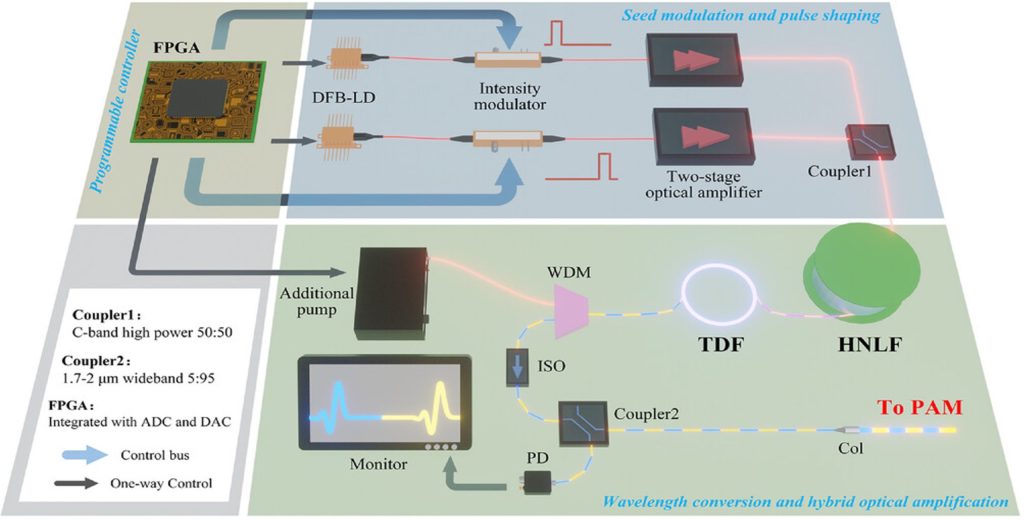
According to the principles of degenerate four-wave mixing (FWM), two high-power seed pulses at specific telecom wavelengths can generate idler waves at longer wavelengths – in this case, at 1725 nm and 1930 nm [3]. Two continuous-wave seed lasers at 1563.23 nm and 1549.50 nm were intensity-modulated with independent EOMs; this pulse carving set the repetition rate, width, and peak power of the seeds entering the high nonlinear optical fiber (HNLF). The Moku:Pro Waveform Generator provided two synchronous EOM drive signals with a 3 ns pulse width, a 100 kHz repetition rate, and a 180° phase difference, ensuring precise alternation between the two seed pulses. Correspondingly, the generated idler waves switched at the same 100 kHz rate, enabling dual-wavelength operation without mechanical tuning or optical realignment.
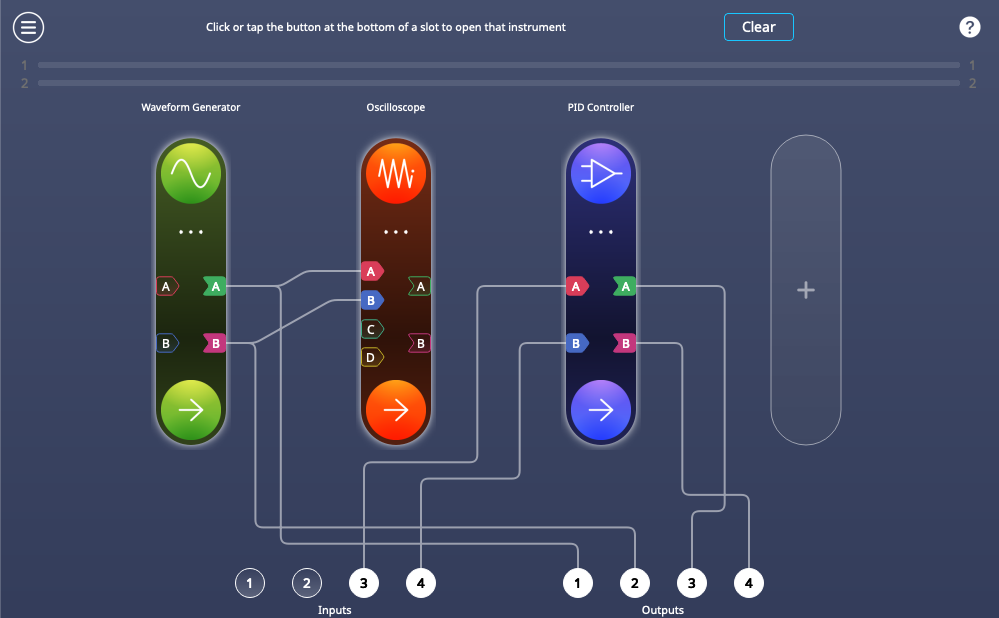
Equally critical was maintaining stable modulation depth for both EOMs. To achieve this, Moku:Pro generated the nanosecond pulses while simultaneously providing a DC bias to each modulator. The RF port handled the fast transients, and the bias port compensated for slow drift. The modulation depth was tuned by adjusting the amplitude of the RF pulses. The EOM’s built-in monitoring photodiodes fed signals back to the Moku:Pro, where the modulation depth was regulated via the Moku PID Controller feedback. This active feedback allows researchers to balance the parametric gain and gain bandwidth of the FWM process inside the nonlinear fiber. The closed-loop stabilization ensured that the modulators operated at the correct point on their transfer curves, preserving suitable on/off contrast and balanced parametric gain throughout long experimental runs. The closed-loop feedback configuration is seen in Figure 2.
The result
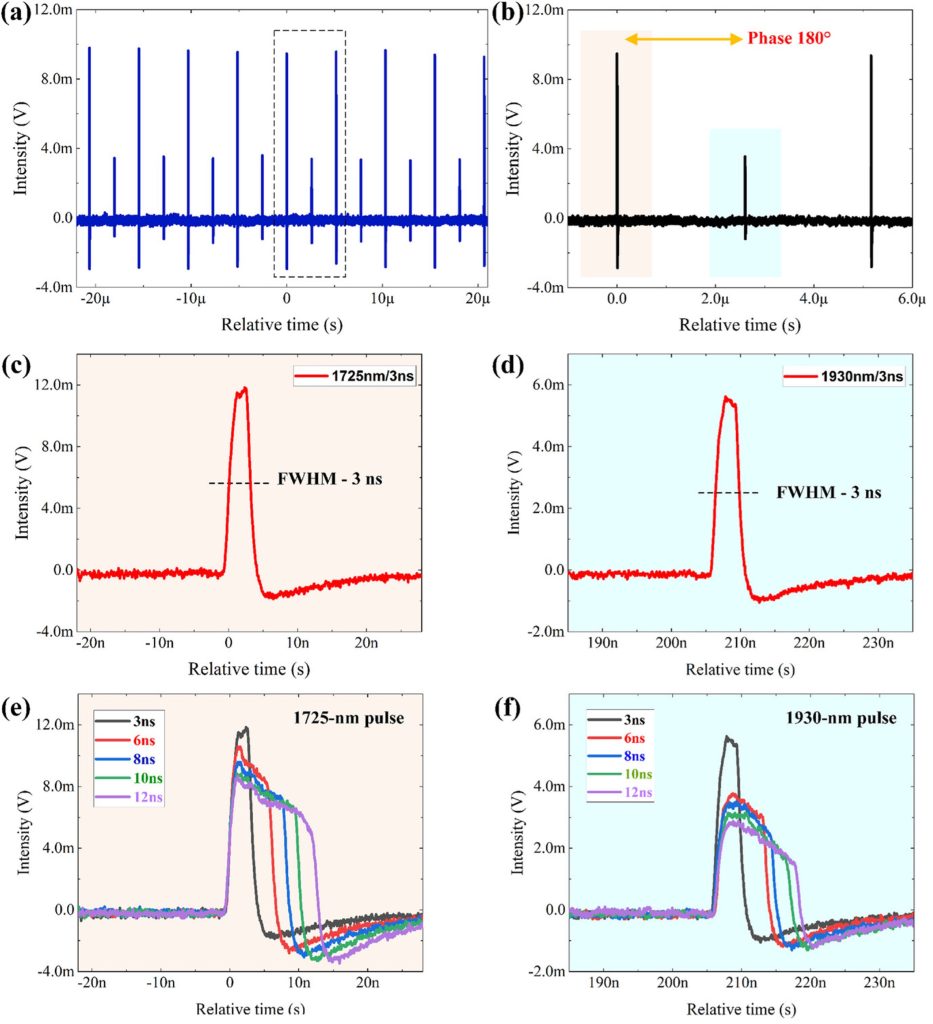
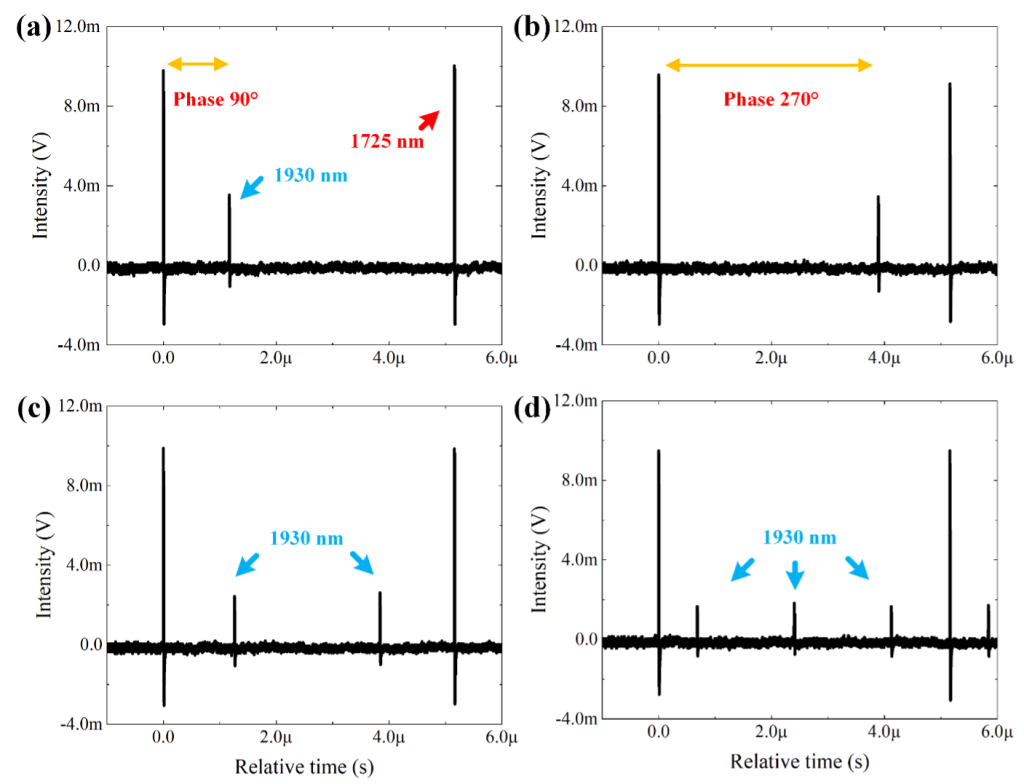
As shown in Figure 3, the researchers achieved clean, alternating optical pulse trains at 1725 nm and 1930 nm, switching at 100 kHz with a 3 ns full-width-at-half-maximum (FWHM) pulse duration. The pulses exhibited a precisely maintained 180° phase difference between the two idler wavelengths, confirming that the Moku:Pro dual waveform outputs maintained perfect synchronization between the two EOMs. Because the waveform generation is entirely programmable, the pulse width for each wavelength was independently adjusted from 3 ns to 12 ns, and arbitrary pulse sequences (Figure 4) were configured directly in the software, with no hardware modification. This flexibility allowed the team to optimize parameters for maximum conversion efficiency and spectral balance within the hybrid optical amplifier.
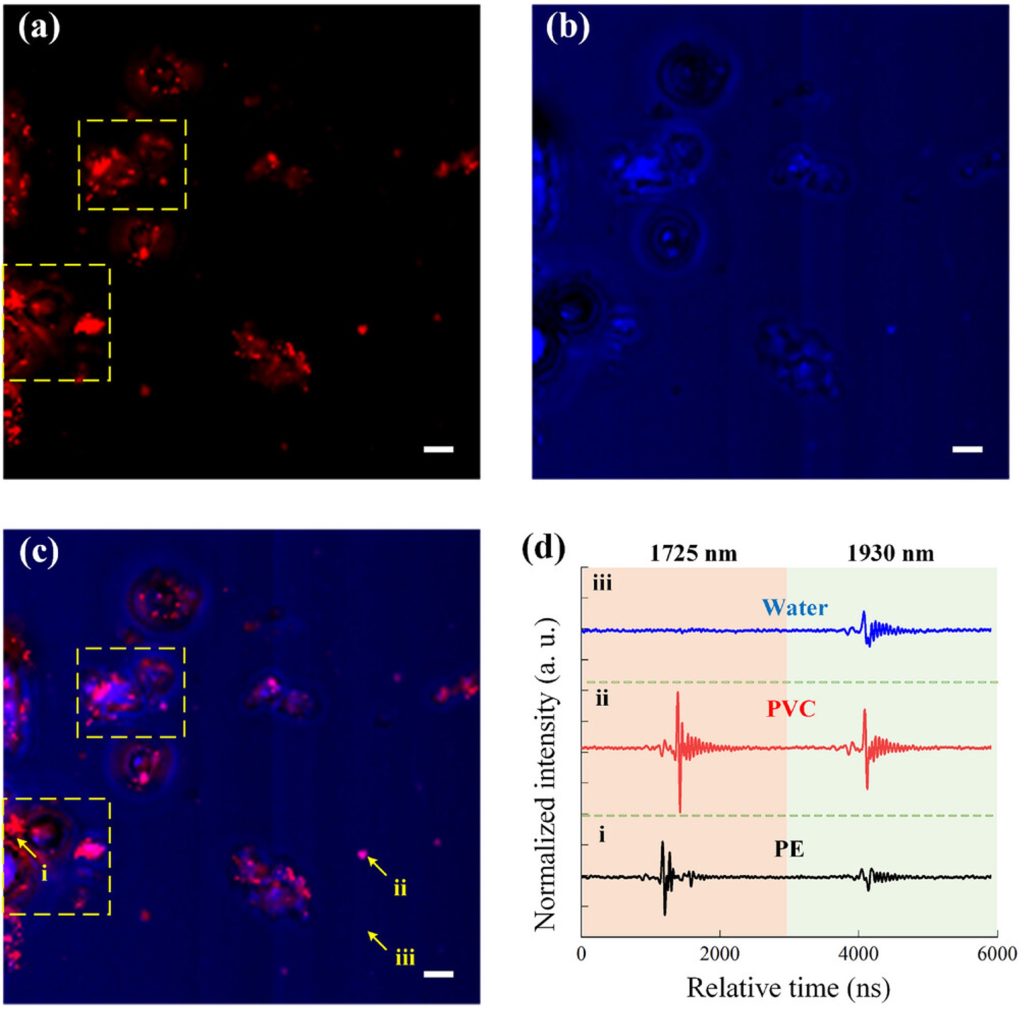
The generated idler beams served as the essential optical excitation source for the dual-wavelength PAM system, enabling label-free chemical imaging in the NIR-III region. Using this platform, the researchers demonstrated multi-contrast imaging of microplastics in water, as presented in Figure 5. At 1725 nm, both polyethylene (PE) and polyvinyl chloride (PVC) microplastics produced strong photoacoustic signals due to absorption from C-H bonds, while at 1910 nm, PVC exhibited much stronger contrast because of its C-Cl and O-H bond absorption. The output wavelengths were finetuned to 1725 nm and 1910 nm to obtain the best contrast. When the two image sets were overlaid, the resulting composite PAM image distinctly separated the two types of plastics, revealing their spatial distribution within the same field of view. The raw photoacoustic traces further confirmed that the two materials produced opposite-polarity signals relative to water, validating the laser’s spectral precision and stability.
Together, these results highlight how Moku:Pro’s integrated waveform generation, synchronization, and PID-based bias stabilization enabled a robust and reconfigurable light source that would be cumbersome to achieve with conventional benchtop instruments. The demonstrated laser delivered high energy, fast switching, and spectral accuracy, directly translating to clear, high-contrast PAM images that open new possibilities for chemical-specific imaging and environmental sensing.
References
[1] Wang, L. V. & Hu, S. Photoacoustic tomography: in vivo imaging from organelles to organs. Science 335, 1458–1462 (2012).
[2] Tong, Y. et al. Programmable dual-wavelength switchable all-fiber laser via hybrid optical amplifier in the NIR-III region for multi-contrast photoacoustic microscopy. Laser Photonics Rev. 19, 2401494 (2025).
[3] Agrawal, G. P. Nonlinear fiber optics. Springer, Berlin (2000).