



Introduction
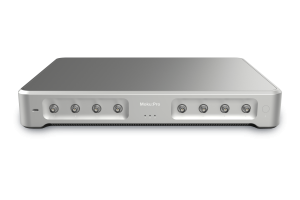
At Chapman University, Dr. Mark Harrison and his research group are designing integrated photonic logic components for digital information processing and optical computing. With limited space and difficult-to-access equipment, efficiency and workflow of the optics and photonics lab are essential. Using Moku:Pro, they have been able to reduce their equipment footprint and cabling clutter, and simplify their workflow with wireless instrument control and data logging from anywhere in the lab.
The challenge
For many researchers, one of the challenges they face is finding enough space to hold all the equipment necessary to conduct experiments. This is especially true in the field of optics and photonics, where in addition to lasers, modulators, and detectors, equipment like waveform generators, oscilloscopes, and lock-in amplifiers are often needed.
“At Chapman University, engineering lab space is shared between faculty and we are particularly space-constrained. The laser lab features two large optical tables with vibration-sensitive optical equipment, and we were constantly shuffling equipment around to make space on the tables,” said Dr. Mark Harrison, Assistant Professor at the Fowler School of Engineering. “Moku:Pro is essential in keeping the lab organized and enabling me to operate my experimental optics and photonics lab.”
Dr. Harrison and his team are designing integrated photonic logic components that operate according to the phase of the light signal. Precisely detecting and recording the phase of a light signal as it changes over time is key to understanding device performance. Using homodyne coherent detection, they extract the relative phase between the output signal of the device under test and the local oscillator (LO).
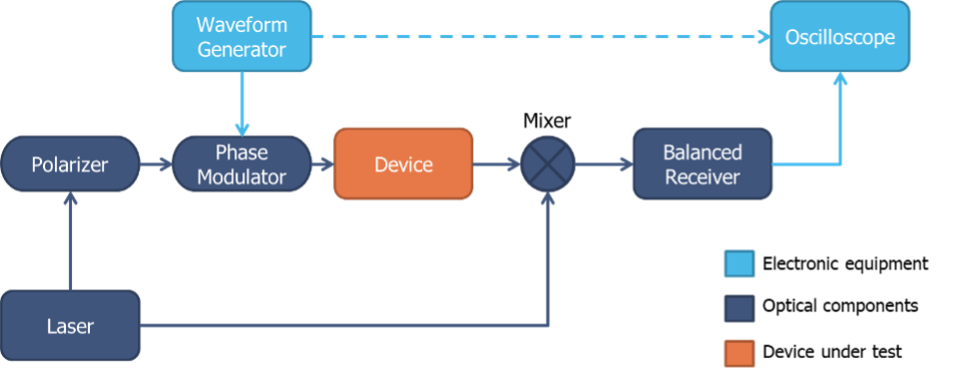
Figure 1: Coherent detection setup with optical components, device under test, and electronic equipment
The coherent detection setup (Figure 1) is fairly complex, consisting of the device being tested, the necessary optical components, and the electronic equipment to operate and record data, namely, a waveform generator and an oscilloscope. The waveform generator drives the phase modulator, and the oscilloscope is used to digitize and view the output of the balanced photoreceiver. It is also useful to view the waveform generator output on the oscilloscope to compare the driving signal directly to the received signal.

The solution
The Moku:Pro serves as both the waveform generator and oscilloscope, saving a substantial amount of space. Using Multi-Instrument Mode (Figure 2), both instruments can be used simultaneously and connections can be routed to external connectors as well as internally between instruments. In this setup, the waveform generator output signal is routed to one of the external connectors, Out 1, to drive the phase modulator, and also internally to the oscilloscope’s Input A for visualization. The oscilloscope’s Input B is mapped to external connector, In 1, and connected to the balanced photoreceiver output signal.
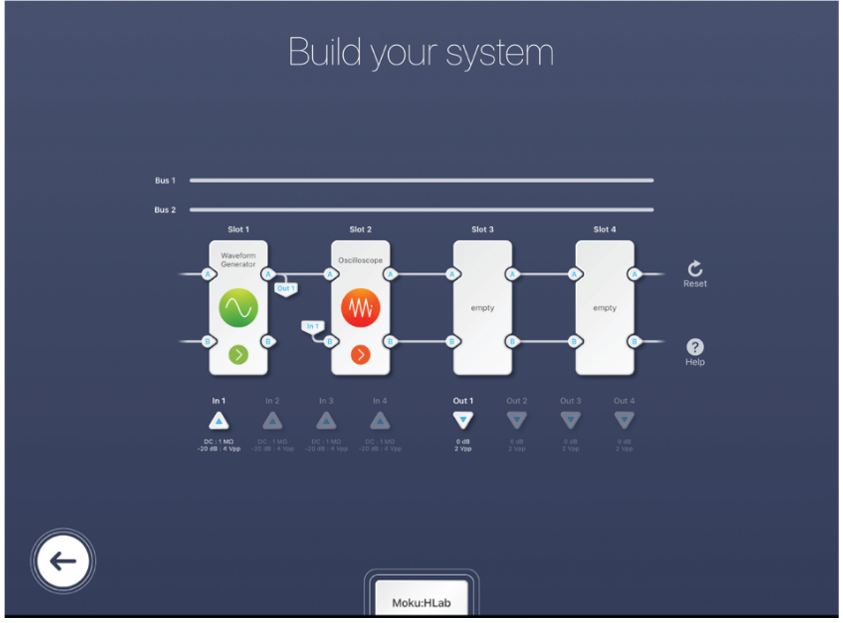
Figure 2: Moku:Pro Multi-Instrument Mode configured with a waveform generator and an oscilloscope, with 2 additional slots for future expansion.
The flexible mapping of signal connections in Multi-Instrument Mode not only reduces the number of BNC cables required, it also alleviates the need to move cables between different input and output connectors, since they can be instantly reconfigured in software. This is especially helpful to the team at Chapman University where the equipment is not easily within reach, located on a hanging shelf above the optical table. The Moku:Pro’s wireless control using the iPad Pro is also key to solving their accessibility problem, allowing them to adjust the waveform generator settings and actively monitor the oscilloscope to view and record data from anywhere in the lab.
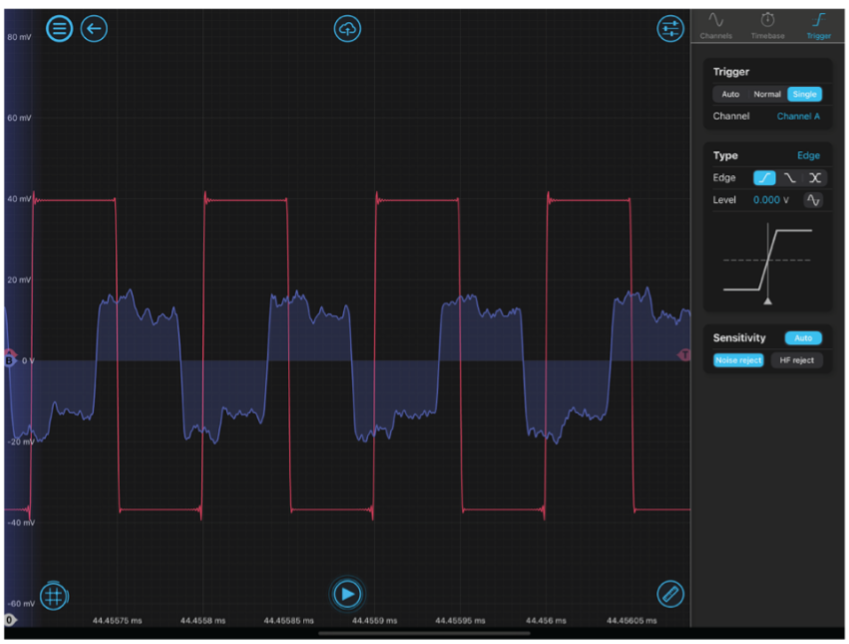
Figure 3: Moku:Pro’s oscilloscope interface showing the output of the waveform generator on channel A in red and the detected coherent signal from the test setup on channel B in purple.
Additionally, with plans for continued test capability expansion, the Moku:Pro provides some “future-proofing” to the Chapman University lab. “We will likely need a lock-in amplifier in the future, and it is nice to know we can use one anytime we want with the Moku:Pro without adding another bulky piece of equipment to the lab,” said Dr. Harrison. Other plans include using Moku Cloud Compile to implement additional processing in real-time on the FPGA to create capability like eye diagrams or pseudo-random bit sequence generation in a cost-effective way.
The result
The Moku:Pro is an essential component in the lab’s optical coherent detection setup. First and foremost, it helped save space which is a resource in short supply at the institution. Secondly, it simplified the experimental setup by allowing researchers to combine the critical electronic pieces of equipment into a single device. It allowed them to reconfigure the electronic components more quickly and easily, saving time. Finally, it will save cost by enabling them to implement more complex or custom capabilities in the future through additional instruments or Moku Cloud Compile.
Have questions or want a printable version?
Please contact us at support@liquidinstruments.com