


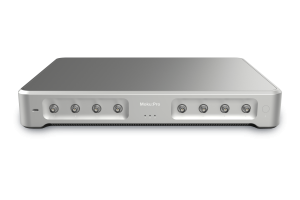
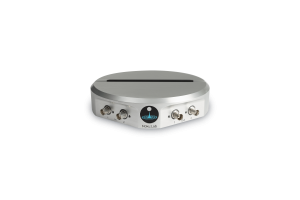
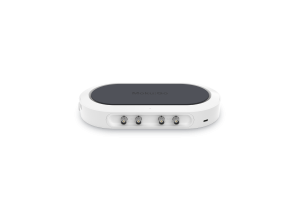

Avik Dutt, Ph.D, an assistant professor, and Sashank Kaushik, a Ph.D. student, of the University of Maryland Institute for Physical Science and Technology conduct photonics research centered around on-chip and fiber devices. Their research focuses on optical ring resonators, or loops of optical fibers. Inside these loops are electro-optic modulators (EOMs) that are used to adjust the spectral information in the resonators. This setup allows the researchers to change or shift the frequency of the light inside the optical fibers, giving them the freedom to engineer different spectral motion across resonators.
Their ultimate goal is to make light behave like matter. An integral part of their fiber optics research is Moku:Pro, an FPGA-based test device from Liquid Instruments that provides access to a reconfigurable suite of 15+ software-defined instruments. Moku:Pro gives the team the tools they need to analyze data, generate RF signals, and control feedback systems — all from a single device.
The challenge
Their experiment consists of a pair of 5.6-meter-long fiber resonators to form a photonic molecule. The fiber-optic resonators can achieve a smaller free spectral range (FSR) and higher configurability compared to microresonators. However, they are more susceptible to thermal, polarization, and mechanical perturbations, which makes advanced stabilization essential for success.
Maintaining the coupled state of two resonators to form a photonic molecule requires subwavelength precision in their lengths, which conventional stabilization methods struggle to achieve. Even small deviations in cavity lengths, such as 150 nm, could disrupt the coupling and prevent the formation of hybridized supermodes and long-term stability. For a single ring resonator, the researchers used the Moku Laser Lock Box to implement the Pound-Drever-Hall (PDH) feedback technique.
While this method works for one cavity, the researchers needed to implement a novel stabilization technique for two coupled cavities. They had to implement cascaded, advanced PID controllers while being able to view and carefully tune the frequency response of each controller. Avik and Sashank needed a wide array of test instruments to get their experiment up and running.
“We wanted a Swiss army knife tool in our toolkit, because buying individual instruments for a bunch of different purposes did not seem like a good use of money for a new lab,” Sashank said. They said that having the ability to use versatile, reconfigurable instruments alongside existing lab equipment would enable far more efficiency than multiple standalone instruments. “How can you program your EOMs to produce the right kinds of signals, how can you measure these things fast enough, and how can we synchronize all our measurements in one turnkey system?” Sashank said. “We’ve been using Moku:Pro and Moku:Go — they have been very, very beneficial.” While the team had access to other test devices such as the Red Pitaya STEMlab, they needed a solution that offered lower noise, higher bandwidth, and better bit resolution to achieve their research goal, and Moku was the ideal choice. Moku also delivered additional built-in functionality that helped tip the scales, including access to a PID Controller and solutions for laser frequency stabilization, all enabled by one device.
The solution
The researchers, led by physics undergrad Dhruv, introduced a novel feedback signal that incorporates the first and second derivatives of the transmission spectrum, shown in Figure 1. By combining these derivatives with digitally implemented PID Controllers on Moku:Pro, they could create a tailored error signal with a unique, asymmetrical zero point at the desired locking position. To fine-tune this approach, the team used a Multi-Instrument Mode setup in Moku:Pro with a Moku Digital Filter Box and multiple PID Controller instruments. The Digital Filter Box contained a low-pass 8th-order Butterworth filter to suppress noise and optimize the feedback response. The PID Controllers enabled the team to analyze and tune the feedback loop directly in the frequency domain.
This approach allowed them to carefully tune the controllers to achieve the exact spectral response needed. The higher-order derivative feedback method implemented via cascaded PID Controllers and Digital Filter Boxes in Multi-Instrument Mode helped Avik, Dhruv and Sashank equalize the cavity length using feedback signals derived from both the first and second derivatives of the transmission spectrum.
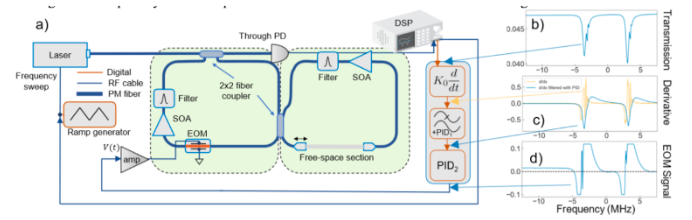
Figure 1: (a) Experimental setup including the PID control loop, consisting of the EOM, PD, SOA, and DSP (Moku). (b) Experimental transmission obtained, and subsequent multi-PID scheme ((c), (d)) to generate error signals to phase-modulate EOM. After the first derivative is taken, fluctuations in transmission due to EOM modulation are suppressed with a low-pass 8th order Butterworth filter implemented via the Moku Digital Filter Box. The signal is then tuned with cascaded Moku PID Controllers. Reproduced from paper.
To generate signals to drive their experiment and measure results, the researchers also cascaded the Moku Oscilloscope and Arbitrary Waveform Generator in Multi-Instrument Mode (Figure 2). The higher bandwidth and cleaner Oscilloscope data for linear sweeps allowed them to more clearly observe the cavity response and laser signals in their experiment, giving them an excellent sense of the quality factor and finesse of their ring cavities.
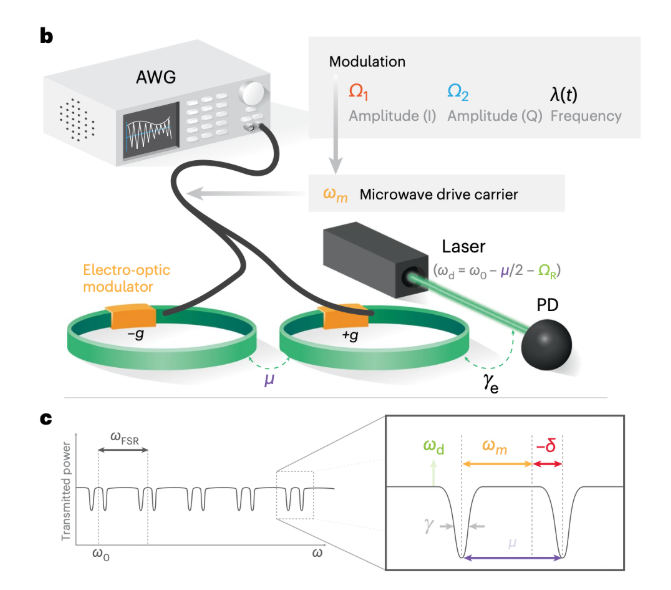
Figure 2: The Moku Arbitrary Waveform Generator in use to drive the EOMs in the experiment. Reproduced from paper.
The result
The cascaded PID technique enables long-term stable studies of nonlinear and topological phenomena in photonic molecules, especially for systems requiring high precision and dynamic, flexible control, such as quantum simulations. The researchers achieved a robust stabilization of the photonic molecule, maintaining a resonance frequency separation of 6.08 ± 0.361 MHz over a 14-second window with significantly reduced drift compared to the unlocked state (Figure 3). The feedback system implemented using Moku:Pro can effectively respond to intentional cavity length changes of 600 nm and quickly restore the coupled state.
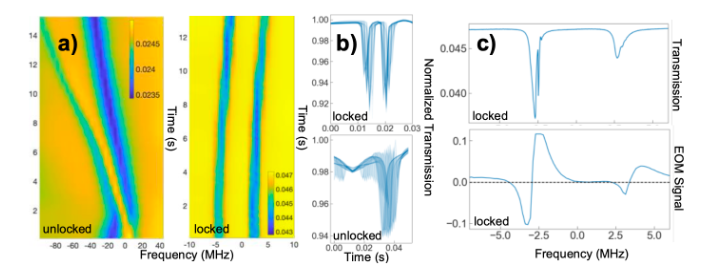
Figure 3: Measured transmission near a photonic molecule supermode over 14 seconds.
Using just the first derivative of the transmission is insufficient to keep the cavity stably coupled, necessitating the higher-order derivative PID control.With Moku, undergraduates working in the lab also got instant access to advanced research equipment. They could use the suite of instruments to track, monitor, and analyze changes in the signals. Technical aspects, like the different parts of a lock box, are often hard to explain to students, but having the signal path shown in the app makes it easy to demonstrate the experimental concepts. “All in all, it’s been a very, very versatile tool for us, especially starting out in a new lab,” Avik said.
Conclusion
This new feedback technique has helped Avik, Dhruv and Sashank overcome many challenges associated with locking coupled fiber cavities, all while utilizing reconfigurable test instrumentation. With Moku, the researchers have access to a flexible, digitally implemented test system that allows for easy experimental adjustments, the ability to analyze and generate signals, and fast test automation. In the future, the team intends to use the Moku APIs to reduce manual testing and automate more measurements. This approach will help them reduce risk in their setups while increasing repeatability. They also want to try using the Moku Time & Frequency Analyzer to synchronize temporal events.
Questions?
Get answers to FAQs in our Knowledge Base
If you have a question about a device feature or instrument function, check out our extensive Knowledge Base to find the answers you’re looking for. You can also quickly see popular articles and refine your search by product or topic.
Join our User Forum to stay connected
Want to request a new feature? Have a support tip to share? From use case examples to new feature announcements and more, the User Forum is your one-stop shop for product updates, as well as connection to Liquid Instruments and our global user community.