


First proposed in the 1980s, quantum key distribution (QKD) offers a way to transmit information more securely than classical methods. In a typical QKD scheme, the transmitter (Alice) encodes classical information via quantum states. This information is sent through a quantum channel to the receiver (Bob). Due to the no-cloning theorem of quantum mechanics, this state information cannot be copied. This makes the channel robust to eavesdroppers (Eve) as they cannot retrieve or copy the transmitted information without alerting Alice and Bob. In this way, QKD can securely transmit sensitive information without the possibility of it being intercepted.
There are many established QKD protocols and methods. Recently, continuous-variable QKD (CV-QKD) has gained popularity due to its compatibility with existing telecommunication infrastructure, using fiber cables, cw lasers, and coherent receivers [1]. This contrasts with other methods which operate at the single-photon level, typically encoding information in the polarization of individual photons. In CV-QKD, information is encoded in the quadrature of a coherent light signal and demodulated at the receiver.
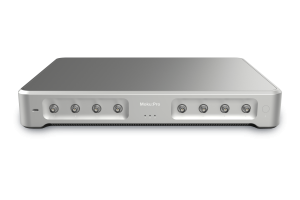
To assist with implementing their CV-QKD scheme, researchers at the University of Hamburg used Moku:Pro, an FPGA-based device from Liquid Instruments that delivers a reconfigurable suite of test and measurement instruments for fast, flexible signal processing and analysis. Leveraging the PID Controller, Lock-in Amplifier, and Laser Lock Box, the group could stabilize the phase of the local oscillator, allowing them to greatly improve the noise performance of their system. Their results were recently published in Optica Quantum [2].
The challenge
In their setup, the team at Hamburg used so-called squeezed vacuum states at the 1550 nm telecommunication wavelength, prepared by pumping a ppKTP crystal with a 775nm laser beam. These squeezed states improve the signal-to-noise ratio in one quadrature at the cost of added noise in the orthogonal quadrature. This can be seen in Figure 1, where the squeezed noise lies below the shot noise of the laser, while in the anti-squeezed quadrature the noise is higher. By encoding the information in the phase modulation of the squeezed quadrature, better noise performance can be achieved. However, like with classical communication techniques, this requires a local oscillator (LO) reference at the receiver in order to decode the phase information.
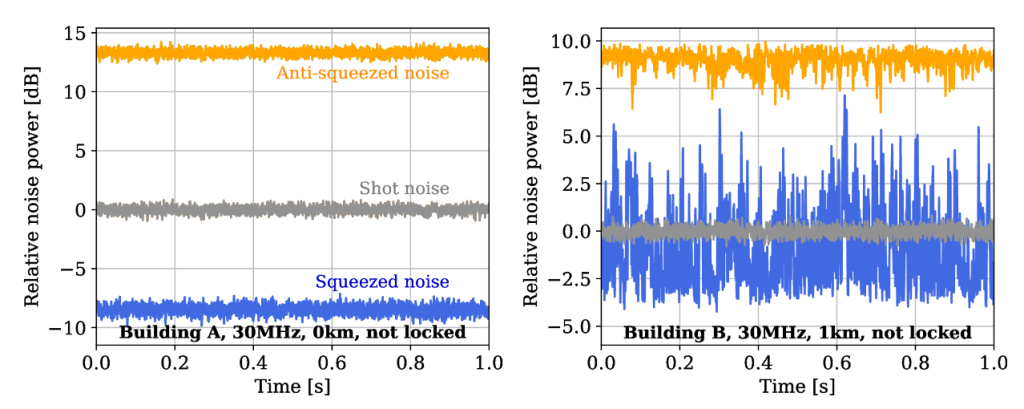
In this setup, the local oscillator is sent from the source to the receiver via a separate parallel channel (see Figure 2). Given the distance that the signal travels (over 1 km), environmental influences such as temperature variations and vibrations distort both the signal and LO, introducing phase fluctuations. This is seen in Figure 1, where the squeezed noise power is far higher after transmission, essentially returning to the level of the shot noise. The team used a balanced homodyne detector scheme, which canceled out the correlated noise between the signal and LO, a standard technique when detecting squeezed states. To counteract the added noise, they added an active feedback mechanism at the receiving end, which requires a series of cascaded PID Controllers to continually adjust and compensate for the phase of the LO.
The solution
Sophie Verclas, a graduate student in the group of Prof. Roman Schnabel, first attempted the active feedback loop illustrated in Figure 2 with analog PID controllers. However, the analog PID controllers could not meet the requirements of the experiment and failed to improve the noise performance.
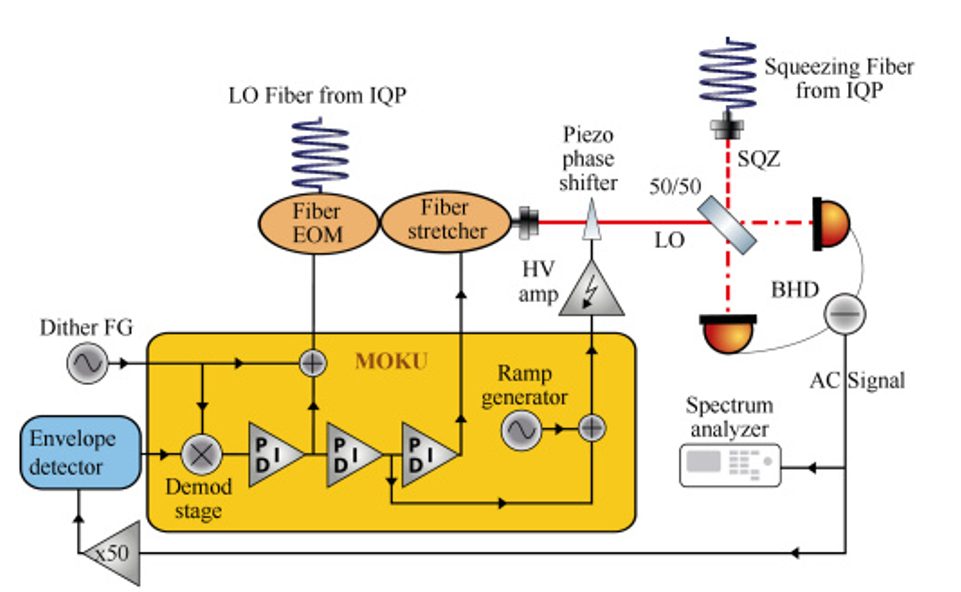
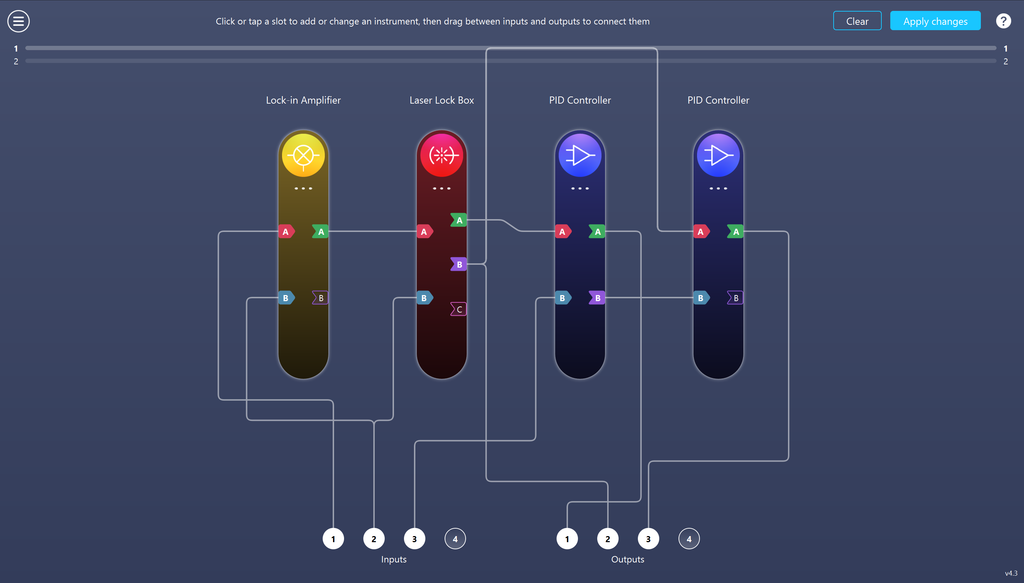
After borrowing and testing a Moku:Pro, she decided to implement it in her own setup. Moku’s Multi-Instrument Mode allowed her to not only replace the analog PID controller, but also deploy a Lock-in Amplifier and Laser Lock Box alongside it. By slowly modulating the LO via a fiber EOM, the error signal could be extracted after detection using the Lock-in Amplifier. The cascaded PID Controllers allowed the control loop to operate over a frequency range of many orders of magnitude, each one providing the feedback signal to a different component. By carefully steering a fiber EOM, piezo mirror, and phase shifter, she could compensate for phase fluctuations ranging from the kHz to sub-hertz range.
Sophie was able to tune the PID Controllers by hand using the Moku app, adjusting the parameters of each controller to fit its specific frequency range. This ensured that her system was robust against the noise introduced by the long distances involved in the measurement sequence.
The result
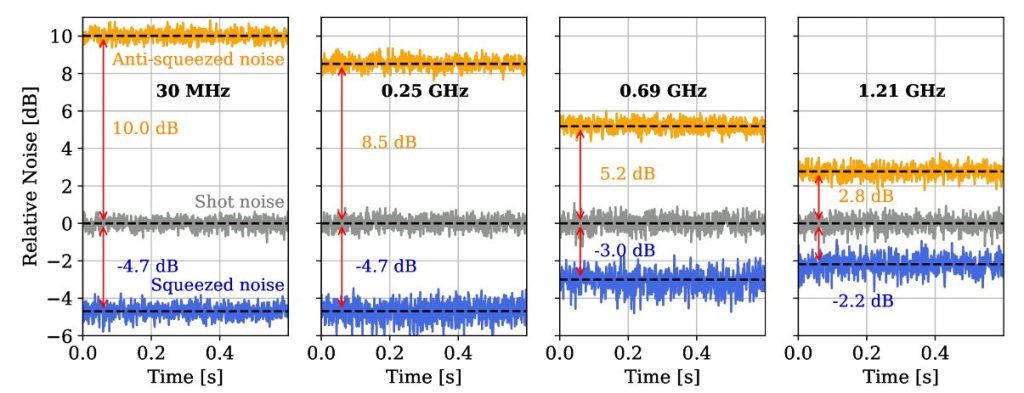
In their published results, the group tested their system by sending squeezed vacuum states over 1 km fibers, with the signal passing between two different buildings on campus. While the noise measurements without the locking scheme (Figure 1) showed heavy degradation of the signal at the point of receiving, adding the phase compensation improved the noise performance dramatically. The locking setup, controlled and coordinated by Moku:Pro, could compensate for the phase noise across the entire bandwidth of the signal, over 1 GHz. The wide bandwidth is essential, as it allows for a high key rate when implementing a CV-QKD protocol. Their results demonstrate that CV-QKD protocols using squeezed states can be an effective way to transmit encoded key information over a short, few-km range quantum channel.
After the publication of their results, the group started to find more uses for Moku:Pro, such as using the Waveform Generator instrument to produce the modulation signal. They also began using Moku Compile to generate custom HDL modules, which were deployed using Custom Instrument. Eventually, Custom Instrument modules replaced the homemade envelope detector, as well as adding a delay generator. Sophie predicts that her group will continue finding more uses for Moku in their lab.
References
[1] Zhang et al. Continuous-variable quantum key distribution system: Past, present, and future. Appl. Phys Rev. 11 011318 (2024). https://doi.org/10.1063/5.0179566
[2] S. Verclas et al. Fiber distribution of phase-stabilized GHz-bandwidth squeezed vacuum states of light between two buildings. Optica Quantum 4, 1-6 (2026). https://doi.org/10.1364/OPTICAQ.567418