

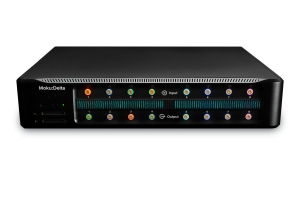
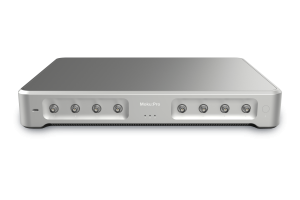

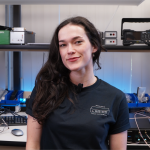
At the Australian National University, Ph.D. candidate Avanish Kulur Ramamohan in the Center for Gravitational Astrophysics is working to enhance precision in differential measurements, like those used in gravitational wave detection, by reducing relative frequency noise. This work contributes to advanced research in metrology, gravitational wave detection, and quantum communications by demonstrating a unique approach for mitigating frequency noise without the need for an extraordinary reference cavity. A core challenge in these systems is the suppression of laser frequency noise, particularly at low Fourier frequencies. The research seeks to demonstrate a novel approach to mitigate this noise without relying on ultrastable reference cavities or highly specialized laser systems. Instead, the team employs a common-mode noise cancellation scheme, using similar lasers and differential readout to suppress uncorrelated noise (Figure 1). By using similar lasers stabilized with Moku:Pro and the Moku Laser Lock Box, Avanish can enable a practical method of noise suppression that is then integrated into a broader class of precision measurements, opening doors for future breakthroughs in sensor technology and fundamental physics experiments.
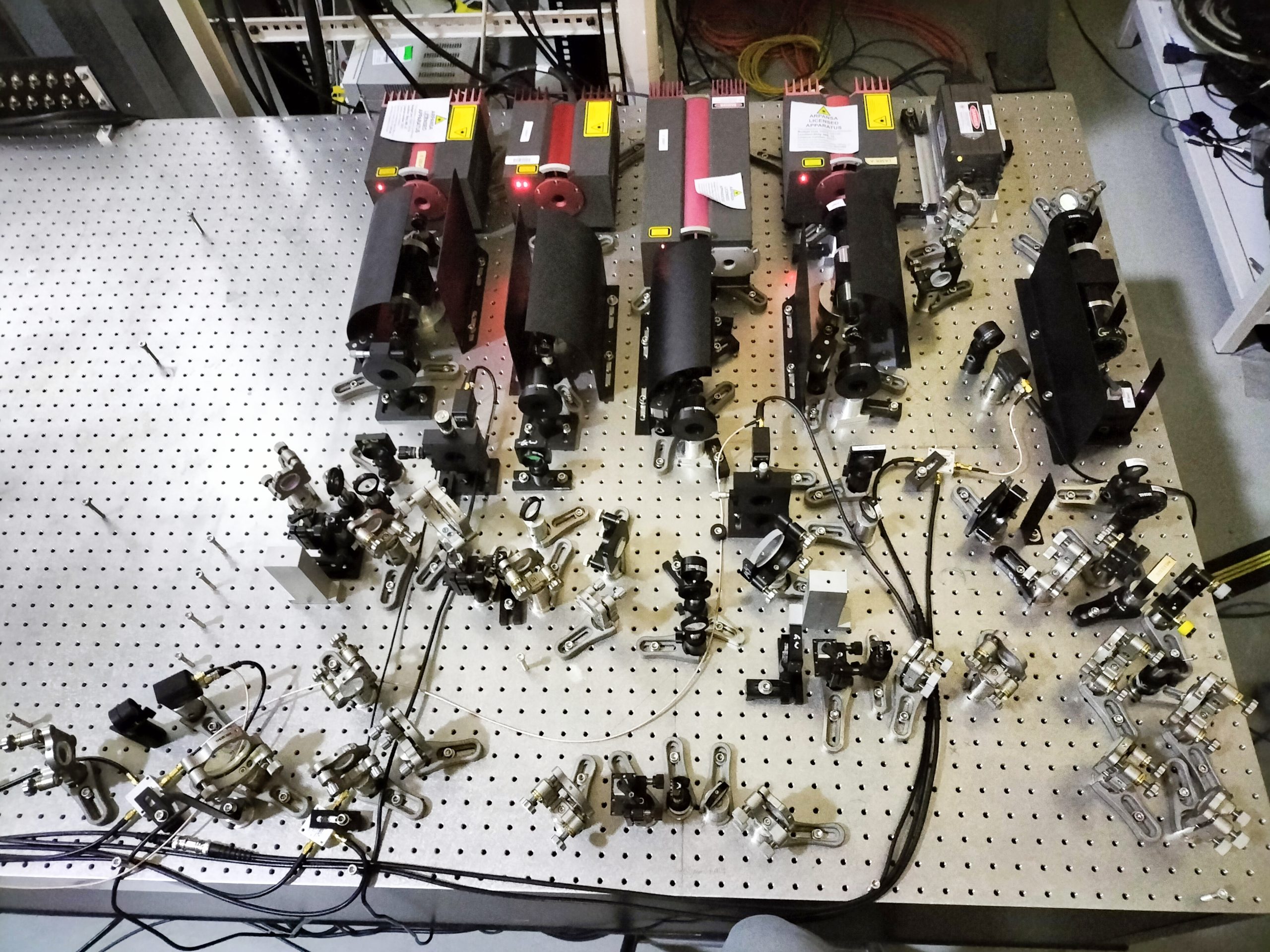
Figure 1: Optical phase locking setup with four PLLs schematic (top, reproduced from paper) and experimental setup (bottom).Having also spun out of the Center for Gravitational Astrophysics at the Australian National University, Liquid Instruments’ Moku devices provide an ideal system for the team to enable precise, low-noise measurements while maintaining the customizability needed in cutting-edge research. Using the Laser Lock Box, Avanish has simultaneously stabilized four optical phase locked loops to achieve suppression of laser frequency noise and achieve large frequency shift dynamic range, in addition to using the Moku Frequency Response Analyzer, Phasemeter, and other instruments for enhanced characterization and control.
The challenge
Laser frequency noise, especially below 1 Hz, is particularly difficult to suppress in low Fourier frequency measurements. In systems where multiple independent lasers are used, uncorrelated frequency fluctuations degrade the signal-to-noise ratio, further degrading measurement accuracy and making it difficult to maintain long-term stability and isolation from environmental noise common in laser frequency stabilization experiments. The setup includes high-end lasers such as the Mephisto 2000NE, Mephisto 500NE, and Lightwave 126-1064-700, multiple digital servo systems with PID control, and both in-loop and out-of-loop photodetectors. To acquire data, the team previously used the Control and Data System (CDS) machine, popular in LIGO-type setups for control loops. However, this method has a maximum data capture of 120 kHz, and had to be complemented with additional servo systems to support both fast and slow PID control. This setup was functionally effective, but increasingly difficult to maintain and achieve the noise performance required for precision measurements. The need to perform complex phase-locking tasks and low-frequency transfer function measurements pushed the limits of the lab’s existing instrumentation. As the experiment evolved, it became clear that a more integrated and flexible system was needed. “My end goal with Moku in this experiment will be employing phase locking for the lasers, which is really important when everything is running,” Avanish said. “With this method, we won’t have frequency noise in the readout.”
The solution
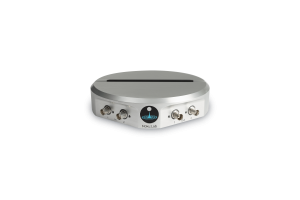
Using Moku:Pro to address these challenges, Avanish could replace multiple tools in his setup with a single device. Gradual adoption began with Moku:Lab to characterize noise before transitioning to full system integration using Moku:Pro. “Looking at the options Moku had, I thought, ‘This device can do everything to achieve the sensor readout,’” Avanish said. “We got a Moku:Pro, and finally I did all my characterization, everything in Moku:Pro. It was very convenient.” With the flexibility and low-noise performance of Moku:Pro, Avanish successfully performed the next phase of experimentation, specifically phase locking. With Moku:Pro, Avanish could perform key analysis, generation, and control tasks with one device, reconfiguring the FPGA in the device to perform different functions. For example, Avanish employed the Frequency Response Analyzer for transfer function measurements (Figure 2b) to characterize the loop seen in Figure 2a and validate feedback control. Using the Moku Data Logger, Waveform Generator, and Phasemeter, he also performed noise measurements and recorded the data.
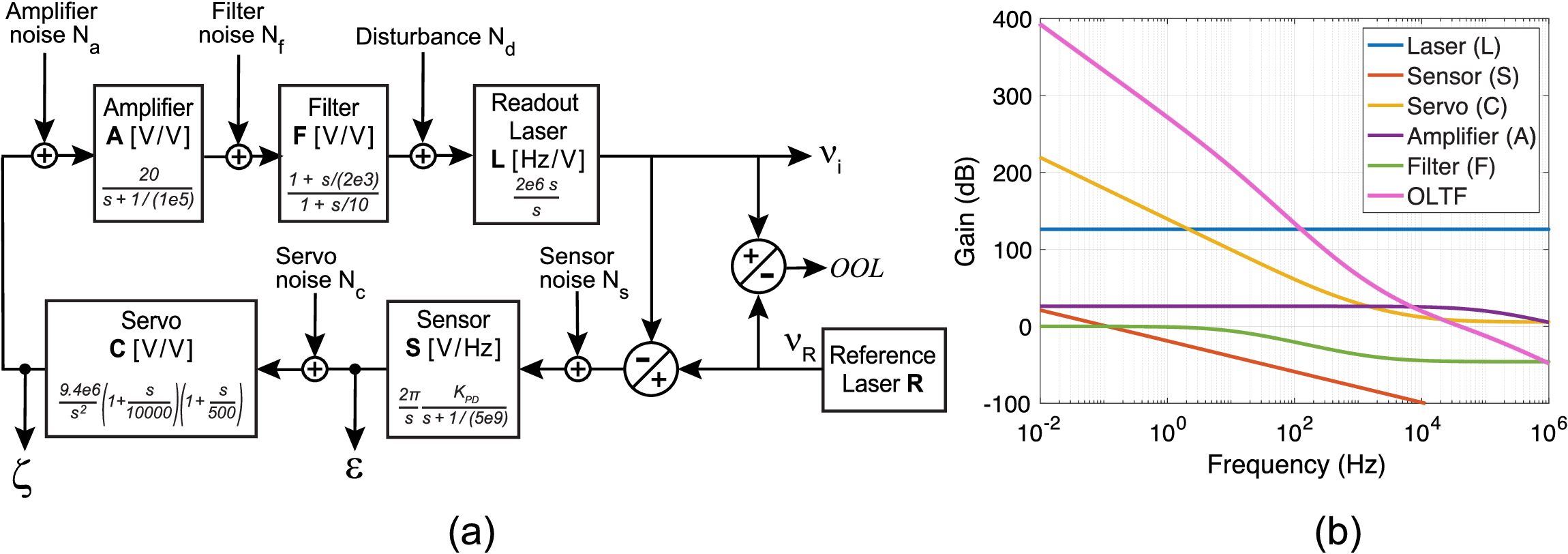
Figure 2: (a) Block diagram of the PLL showing the in-loop block component descriptors, in-loop input noise points, and error signal and control signal extraction points. The Servo refers to the Moku PID Controller. (b) The gain response of the loop component blocks and open-loop transfer function (OLTF), captured with the Moku Frequency Response Analyzer. Reproduced from paper.At the core of the experiment, Moku:Pro uses Multi-Instrument Mode, a partial reconfiguration of the FPGA inside the device, to deploy four independent Laser Lock Box instruments simultaneously, each running its own optical phase lock loop (OPLL). With four integrated Laser Lock Box instruments, the team maintained precise phase control across the system while minimizing the complexity of the setup.
The result
With Moku:Pro, Avanish achieved stable, low-noise phase locking while maintaining loop stability across a wide tuning range seen in Figure 3a. One key experimental result demonstrates successful phase locking of the local oscillator while tuning over a +/- 100 MHz span, without any interruption of the lock, with frequency deviation seen in Figure 3b.
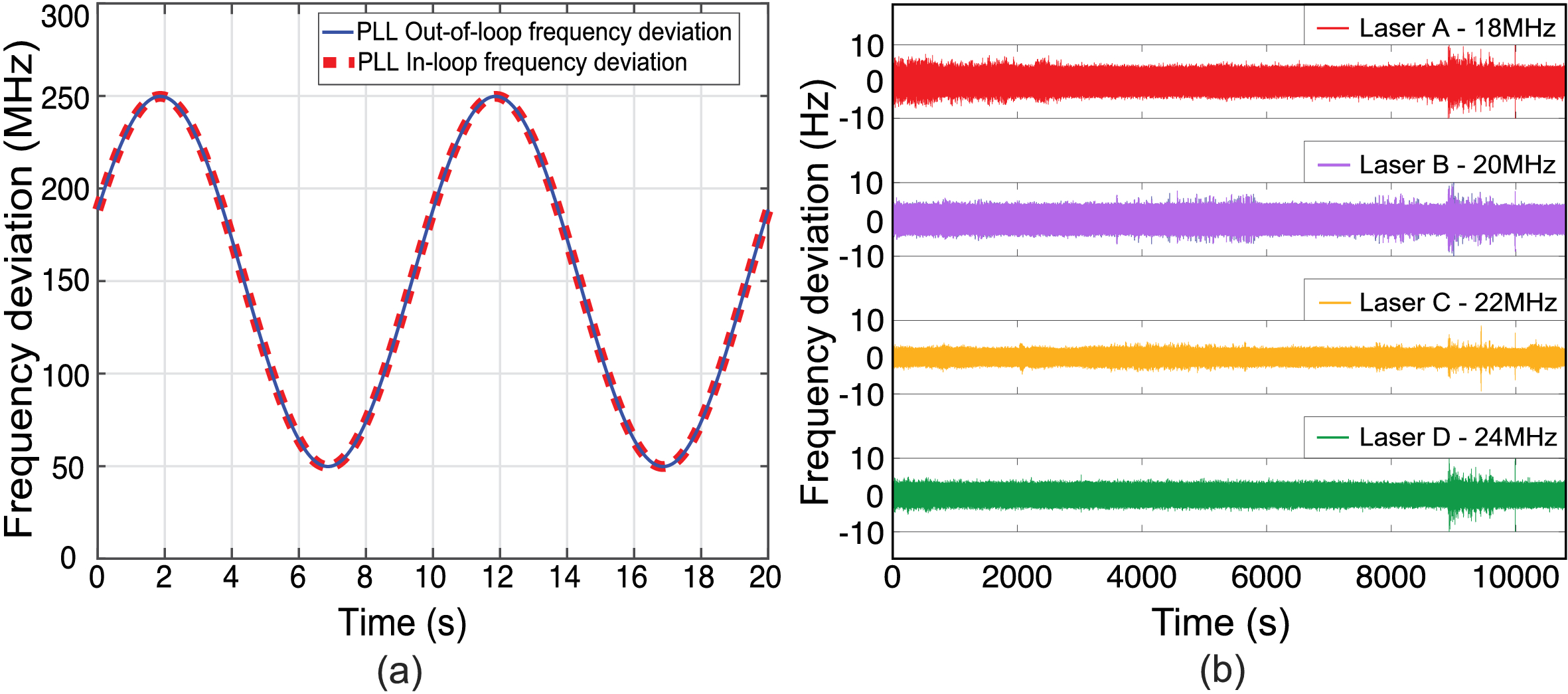
Figure 3: Frequency deviation measurements of the in-loop and out-of-loop beat notes of a PLL. 3(a) were taken with the Moku Phasemeter, and time-series measurements of the out-of-loop beat note frequency deviations in 3(b) were taken with an NI 5761. Reproduced from paper.“If I had to do that manually or with an analog system, I don’t think I would have had access to this much with the local oscillator, especially due to Moku’s noise floor being so low,” Avanish said. “That’s one of the key features I appreciate about Moku.” With the Laser Lock Box in Multi-Instrument Mode, seen on-screen in Figure 4, Avanish could overcome various inherent and performance-based challenges to achieve precise phase locking. All with far better noise performance and stability than alternative solutions. Using this same technique, he has begun to perform Pound-Drever-Hall locking using the Moku:Pro Laser Lock Box, with additional results expected later this year.
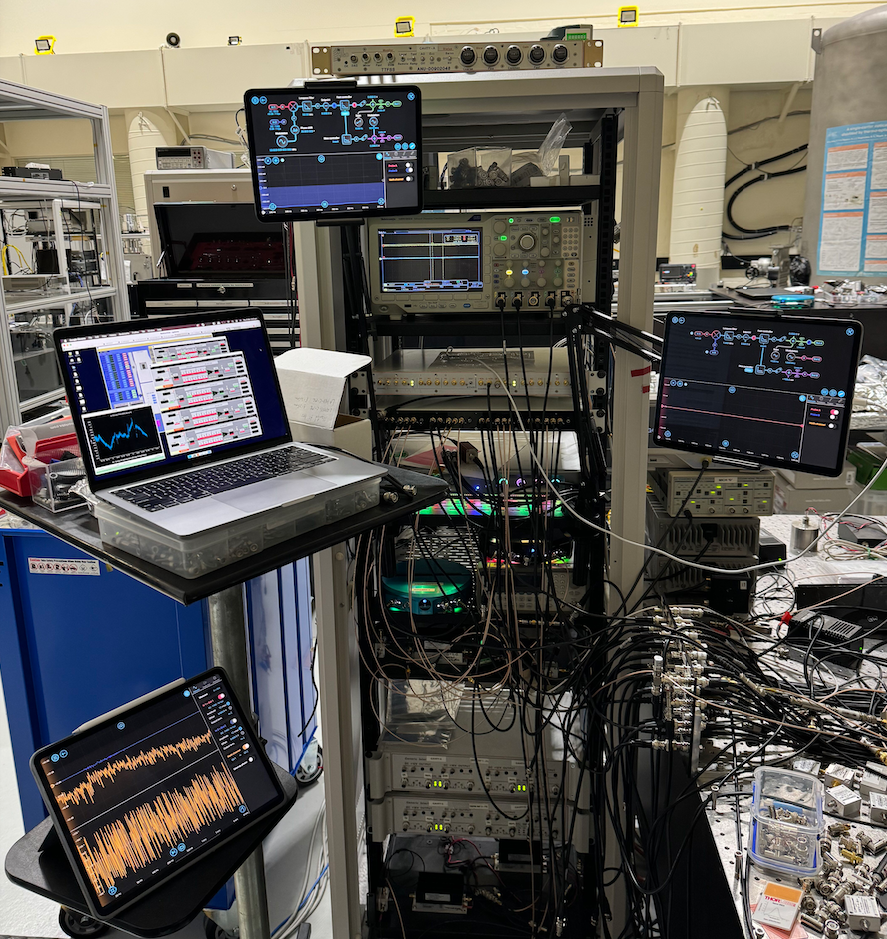
Figure 4: Test rack with various test equipment including two Moku:Lab devices and one Moku:Pro device, seen in the center of the rack. The Laser Lock Box instruments can be seen on the two upper iPad screens, while the Frequency Response Analyzer gain and phase plots can be seen on the bottom left iPad screen.Another key instrument in the locking setup, the Moku PID Controller, enabled high gain at low frequency through the use of the built-in double integrator. “That is how it helped the experiment to achieve such high suppression of frequency noise,” Avanish said. “I don’t know of any other device that could bring out that much gain at low frequency to achieve such a frequency noise performance. That’s exactly what I wanted — there’s no other device that could do that.”
Conclusion
Avanish and his team’s work not only addresses longstanding technical challenges in precision measurement, but also offers a scalable model for future research in gravitational sensing, metrology, and quantum systems. The team’s use of Moku:Pro exemplifies the powerful intersection of flexible instrumentation and high-impact physics research, with more publications on the horizon. Notably, Avanish and his team are commissioning a torsion pendulum dial oscillator (TorPeDO). Using this implementation and the Moku:Pro Laser Lock Box to perform Pound-Drever-Hall locking on four lasers simultaneously, the team can directly measure Newtonian noise, or gravity gradient noise, and control the measurement laser frequency to closely follow the TorPeDO cavity length changes (Figure 5).
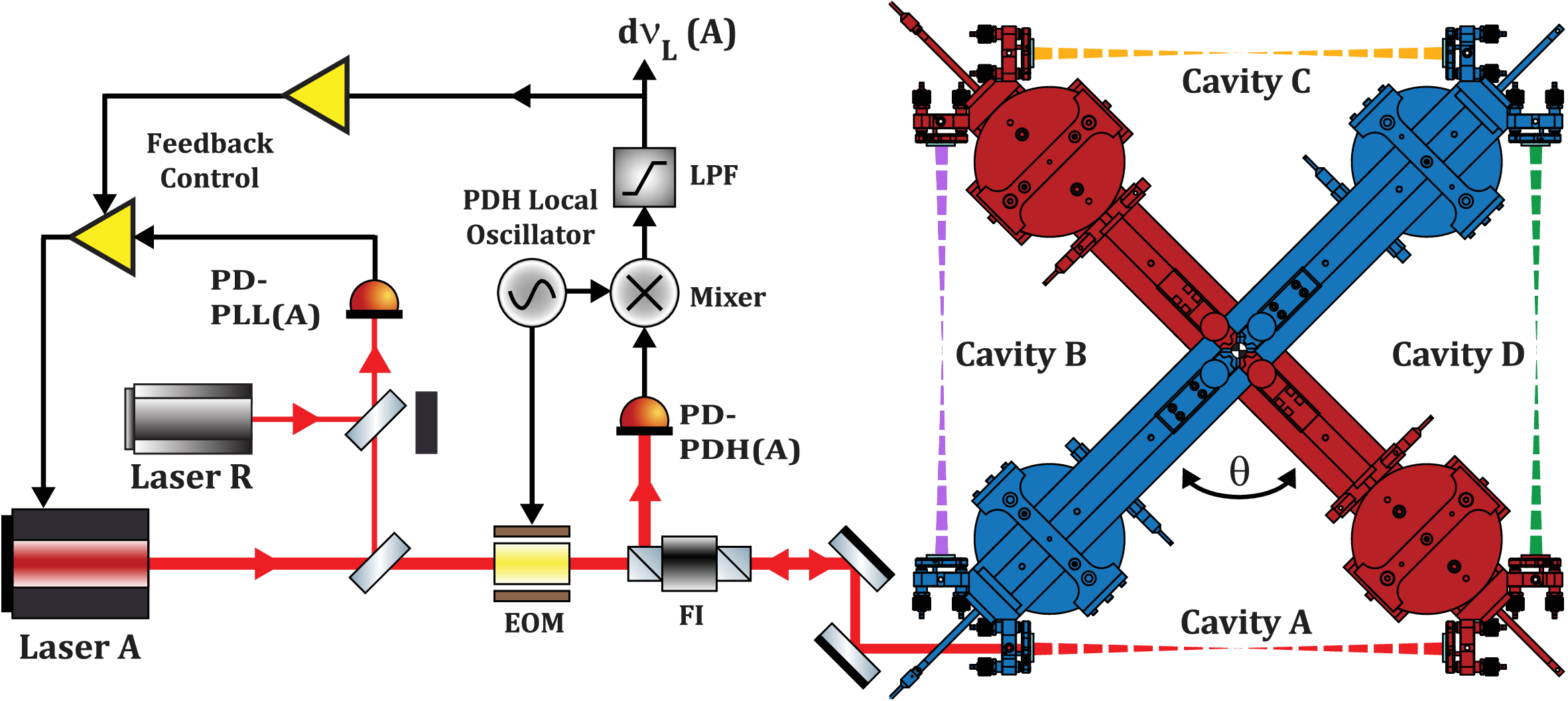
Figure 5: ToRPeDO sensor schematic. Feedback control, the low-pass filter (LPF), mixer, and PDH local oscillator are contained within Moku:Pro. Reproduced from paper.
Moku:Pro has become an indispensable tool in this gravitational physics lab, enabling high-performance phase locking, low-frequency noise suppression, and integrated system control within a single reconfigurable device.To learn more about Avanish and his team’s experiment, read the full paper here.