
Please update your browser. For the best Liquid Instruments experience, update to the latest version of Chrome, Edge, Firefox, or Safari. Update Microsoft Edge.
Liquid Instruments Logo
Products
Hardware Platforms
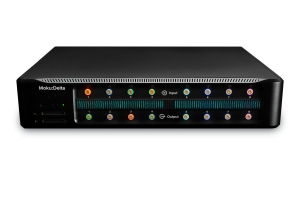
Moku:Delta
Moku:Delta
New
For advanced design and validation
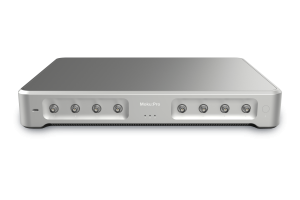
Moku:Pro
Moku:ProFor versatile test and measurement
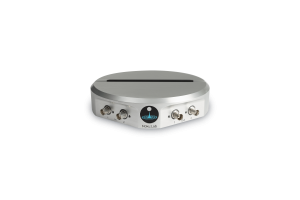
Moku:Lab
Moku:LabFor experimental research labs
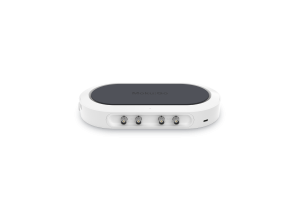
Moku:Go
Moku:GoFor quick testing and debugging
Compare Hardware
Compare HardwareView a side-by-side of all Moku hardware
Technologies
GenInst Studio
New
Generate personalized instruments
Integrated InstrumentsProfessional-grade instruments at your fingertips
Neural NetworkFPGA-powered neural network integration
Multi-Instrument ModeCombine instruments to create a customized test system
Moku CompileCode, compile, and deploy to your Moku's FPGA
Software
MokuOSDownload the Moku app for Windows, macOS, iPadOS & visionOS
APIsPython, MATLAB, LabVIEW
UtilitiesCommand line and graphical tools for file conversion
Instruments
Analysis
Oscilloscope
Spectrum Analyzer
Frequency Response Analyzer
Lock-in Amplifier
Phasemeter
Logic Analyzer / Pattern Generator
Time & Frequency Analyzer
Data Logger
Generation
Waveform Generator
Arbitrary Waveform Generator
Control & Conditioning
PID Controller
Digital Filter Box
FIR Filter Builder
Laser Lock Box
Custom & Utility
GenInst Studio
New
Gigabit Streamer
Custom Instrument
Neural Network
Multi-Instrument Mode
Applications
Optics and Photonics
Microscopy and Spectroscopy
Photon Counting
Quantum Optics
Aerospace and defense
A&D Instrumentation
Component Test
Automated Testing
Semiconductor Test
Control Systems and Bode Analysis
MEMS Testing
AI and Machine Learning
Generative Instrumentation
New
Neural Networks
Education
Education and Research
Resources
App Notes
Blog
Case Studies
Coursework
Guides
Product Documentation
Publications
Webinars
White Papers
Support
Company
Contact Us
About Us
Leadership
Partners
News & Updates
Press
Events Calendar
Careers
Store
Moku:Delta
Moku:Pro
Moku:Go
Upgrade Moku:Pro
Upgrade Moku:Lab
Upgrade Moku:Go
0
Get a quote Buy Now
Build personalized instruments with GenInst Studio in minutes, not months. | Register for the webinar
Case studies

Using Moku:Pro for photonic IC control system research at Intel Labs

Flexible, reconfigurable solution accelerates development timelines and reduces experimental complexity

February 3, 2023

    Introduction

    Researchers at Intel Labs’ photonic device research lab are working on a range of cutting-edge projects to advance and maximize the advantages of heterogeneously integrated silicon photonic integrated circuits (PICs). As team members typically explore new designs at a rapid pace in a highly experimental setting, they need reconfigurable, scalable tools with a small footprint to adapt to various situations. With multiple integrated Lock-in Amplifiers (Figure 1), Spectrum Analyzers, Frequency Response Analyzers, and PID Controllers on Moku:Pro, along with a best-in-class user experience, the team has achieved significant time savings and reduced complexity to advance progress and deliver results.

    Moku Pro Lock-in Amplifier

    Figure 1: Moku:Pro Lock-in Amplifier iPad interface

    The challenge

    One specific challenge associated with PIC testing is to find the optimal bias condition for all the on-chip optical phase tuners, so the system functions as desired. Though this can be accomplished with multidimensional sweeps or optimization routines, script complexity and calculation time quickly become significant as more phase tuners are involved. Controlling the tuners with analog, single-function benchtop instruments (e.g., conventional lock-in amplifiers, PID controllers, etc.) may avoid the problems, but cabling and footprint make this approach cumbersome when dealing with large tuner counts. Moreover, the lack of a modern user interface in these conventional instruments makes knowledge transfer to new researchers difficult when working on photonic IC control.

    The solution

    With the advanced functionality, instrument specifications, and reconfigurability offered by Moku:Pro, Intel Labs researchers can utilize two Lock-in Amplifiers and two PID Controllers simultaneously in Multi-Instrument Mode (Figure 2). This flexibility significantly minimizes their overall equipment footprint and reduces the necessary cabling. Since Moku:Pro provides an analog output range of 10 Vpp, the team no longer needs external amplification for experiments involving high voltages. The high-precision front end ensures excellent signal clarity with high resolution. The researchers also appreciate the device’s intuitive graphical user interface, which is easy to understand, simple to use, and offers convenient block diagrams to reinforce system-level understanding across the experiment. Having the ability to save and load Multi-Instrument Mode configurations between experiments has optimized timelines and enabled efficient knowledge transfer among team members. Looking forward, the team can further streamline testing by utilizing Moku Cloud Compile to prototype control algorithms before deploying. This will enable them to prototype control algorithms and deploy them to the Moku:Pro FPGA for real-time, closed-loop system-level characterization.
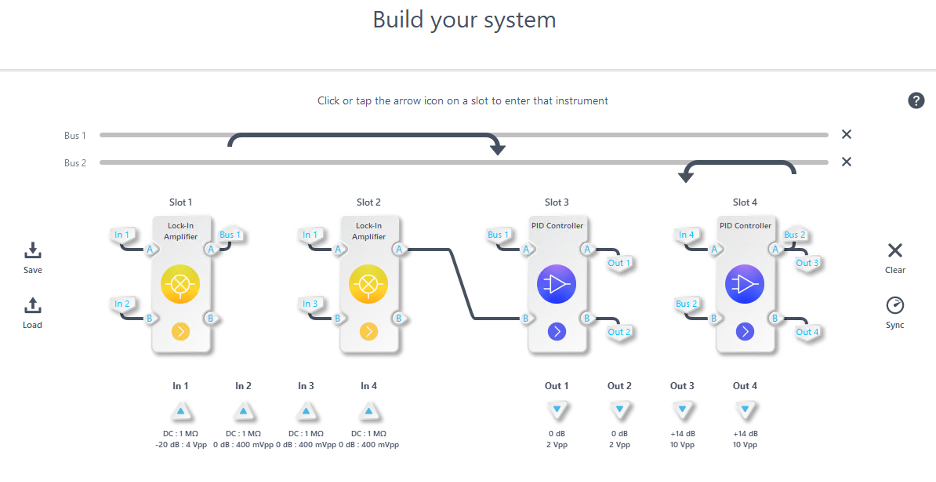
    Multi-instrument Mode setup at Intel Labs

    Figure 2: Configuring multiple Moku:Pro Lock-in Amplifiers and PID Controllers in Multi-Instrument Mode

    The result

    Thanks to Moku:Pro, researchers at Intel Labs have significantly streamlined their workflow across advanced experimental projects for photonic IC control systems. “Instead of the hundreds of steps needed to converge when using a multidimensional sweep, Moku:Pro helped us accomplish this in just a few iterations,” said Dr. Guan-lin Su, Photonics Research Scientist at Intel Labs. Because multiple instruments are offered on one device, experiment setup is now faster and much more efficient.

    Conclusion

    Moku:Pro enables easier, faster tuning of control loops to optimize experiments and maximize time savings at Intel Labs. The team has also enjoyed the advantages of being able to use more than two lock-ins for complex DUTs, and the ability to save different Multi-Instrument Mode configurations in separate files for seamless transfer between multiple users, accelerating development timelines. As their research progresses, integrating Moku Cloud Compile will enable faster, more agile prototyping and design.

    To learn more about Moku:Pro, contact Sales.

    Try Moku in demo mode Download the Moku app → Get answers to FAQs Visit Knowledge Base → Connect with Moku users Join the user forum →

    Other Recommended Case studies

    Case studies
    Phase Stabilization for Quantum Key Distribution with Moku:Pro

    Learn how researchers at the University of Hamburg are using Moku to improve signal fidelity for continuous-variable QKD.

    Featuring: Moku:Pro, PID Controller, Lock-in Amplifier, Laser Lock Box

    Date: Mar 16, 2026

    Case studies
    Enabling Dual-Wavelength Nanosecond Fiber Lasers for Multi-Contrast Photoacoustic Imaging with Moku:Pro

    Learn how researchers at the University of Hong Kong used Moku:Pro to generate synchronized shortwave-infrared nanosecond pulses and stabilize modulation depth for dual-wavelength photoacoustic imaging.

    Featuring: Moku:Pro, Waveform Generator, PID Controller

    Date: Dec-19-2025

    Case studies
    Teaching lock-in detection with Moku:Go

    Learn how students at IIT Madras are gaining hands-on experience in using the Lock-in Amplifier instrument on Moku:Go

    Featuring: Moku:Go, Lock-in Amplifier

    Date: Dec-15-2025

    Back to all Case studies

    Nav

    • Products
    • Instruments
    • Resources
    • Support
    • Company
    • Contact Us
    • Privacy Policy
    • Terms of Use

    Offices

    United States
    (619) 332-6230
    12526 High Bluff Dr.
    Suite 150
    San Diego, CA 92130

    Australia
    +61 2 6171 9730
    243 Northbourne Avenue
    Suite 1, Level 1
    Lyneham, ACT 2602

    Australia
    +61 3 7073 3594
    Suite 5C, Level 5,
    700 Swanston Street,
    Carlton, VIC – 3058


    Follow us

    LinkedIn YouTube X Facebook Instagram

    官方微信

    © 2026 Liquid Instruments. All rights reserved.