

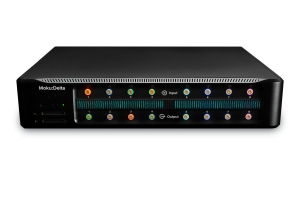
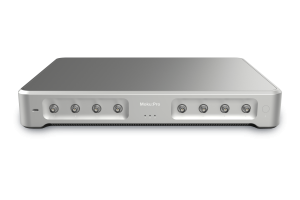

This white paper provides an overview of a multi-frequency lock-in amplifier utilizing Multi-Instrument Mode on the Moku:Pro. Moku hardware platforms combine precision analog hardware with FPGA-based digital signal processing in a fully reconfigurable architecture. With Multi-Instrument Mode, multiple instruments traditionally requiring separate hardware or modules can be configured and operated together on a single Moku, with instruments and signal routing operating in parallel on the internal FPGA.
Through dynamic FPGA reconfiguration, instruments can be independently changed without affecting the remaining instruments in the system. Signals can also be routed directly between instruments in the digital domain without leaving the FPGA, enabling high data rates and ultra-low-latency processing while avoiding the additional analog-to-digital and digital-to-analog conversion stages associated with routing signals between separate hardware instruments. For this implementation, multiple Lock-in Amplifiers are deployed simultaneously in Multi-Instrument Mode on Moku:Pro, enabling multi-frequency and multi-harmonic demodulation on a single hardware platform.
Multi-Instrument Mode Architecture
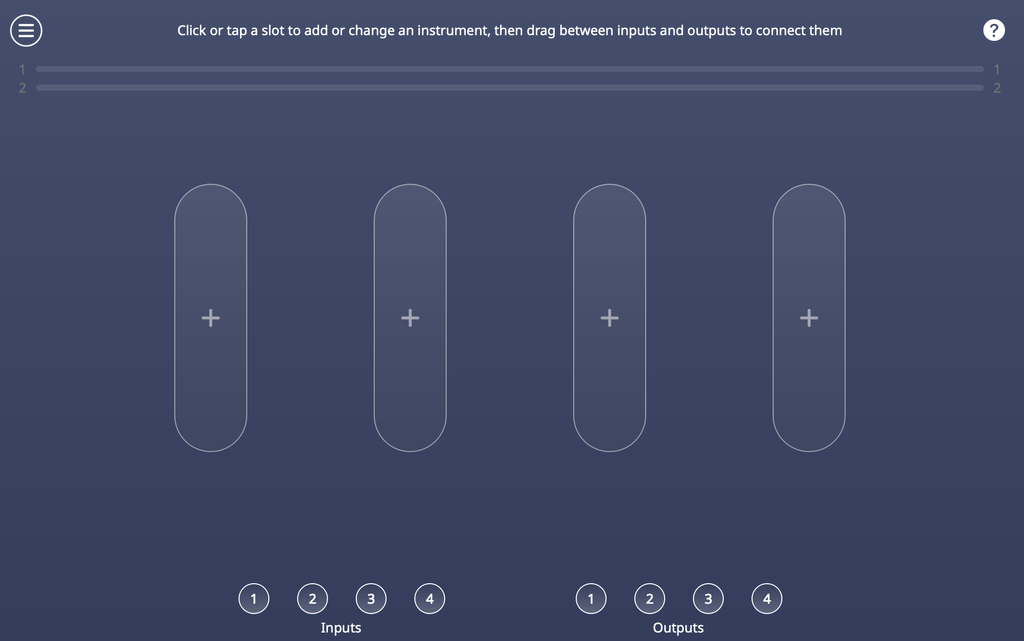
Figure 1 shows the starting point of building a multi-instrument system. Moku:Pro’s FPGA is divided into 4 instrument “slots”. Each slot represents a segment within the UltraScale+ FPGA and has access to Moku:Pro’s analog inputs and outputs. Signals can be passed between these instruments in the digital domain and without ever leaving the FPGA and are therefore lossless with deterministic, nanosecond-level latency. All 4 slots can be phase synchronized with one tap of the “Sync” button. Users have the flexibility to place Moku:Pro’s individual instruments into these slots, for example the Spectrum Analyzer, Oscilloscope, and PID Controller can be deployed simultaneously.
Multiple oscillators, multiple harmonics: Using the Lock-in Amplifier in Multi-Instrument Mode
Lock-in Amplifiers extract the amplitude and phase of a single frequency component from a noisy background by mixing the input signal with a known stable local oscillator prior to filtering. In some applications, users require the amplitude and phase information at multiple frequencies simultaneously, either from harmonics of a single oscillator or multiple oscillators of arbitrary frequency. This often requires additional hardware, signal splitters, or multiple lock-in amplifiers.
With Multi-Instrument Mode, users now have the flexibility of placing up to four Lock-in Amplifiers in the instrument slots. This removes the need for multiple hardware units and simplifies complex lab setups, reducing costs and configuration time. Each Lock-in Amplifier can be configured independently with its own local oscillator, enabling the user to demodulate 4 signals of arbitrary frequency including, for example, a fundamental and 3 harmonics, etc. Moku:Pro can demodulate 4 signals up to 600 MHz with 120dB of dynamic range and superior blended ADC noise figures.
Each Lock-in Amplifier can also be connected to other embedded instruments, enabling pre or post-signal conditioning, data visualization, and data logging.
Figure 2 shows a Multi-Instrument Mode configuration with three Lock-in Amplifiers and an Oscilloscope.
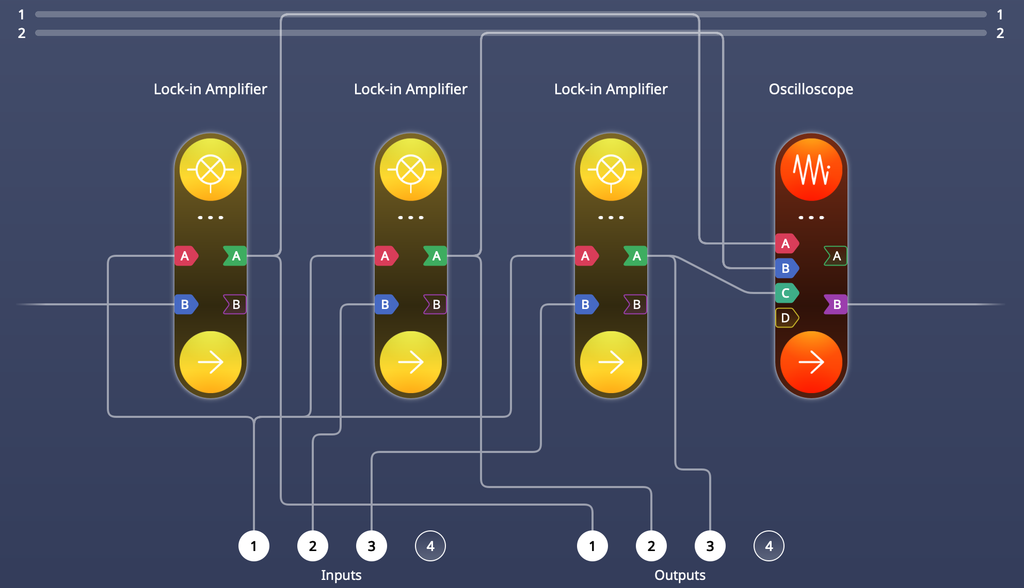
The measurement signal, containing the weak component of interest buried in noise, is fed into analog input 1 on Moku:Pro and is digitized by the corresponding ADC. The digitized signal is then routed internally on the internal FPGA to slots 1, 2, and 3 for parallel demodulation by the three Lock-in Amplifiers. The local oscillators in each Lock-in slot are set to the fundamental or a specific harmonic of the modulation frequency and are synchronized in phase, maintaining a consistent phase relationship across the demodulation channels for accurate multi-frequency and multi-harmonic measurements.
Following demodulation, the resulting signals are then internally routed to DACs 1, 2, and 3 for conversion to analog signals at the corresponding Moku:Pro outputs. Simultaneously, the Oscilloscope in Slot 4 is configured to observe the signals from all three Lock-in Amplifiers, allowing the demodulated outputs to be monitored and compared in real time without requiring additional measurement hardware.
Signal routing between instruments is designed to be highly flexible. Each slot can access the hardware inputs and outputs, while high-speed digital signals can be passed directly between adjacent slots or routed over internal signal buses to instruments in non-adjacent slots. Utilizing the dynamic reconfigurable nature of the internal FPGA, the Lock-in slots 1, 2, and 3, can be left operating while the Oscilloscope is seamlessly swapped with the Spectrum Analyzer. This allows the frequency components to be observed without disturbing the Lock-in Amplifiers. Additional instruments, such as PID Controllers, filters, and signal generators, can be deployed alongside the Lock-in Amplifiers to perform real-time control, verification, analysis, and further signal processing in parallel.
Conclusion
The Moku:Pro digital Lock-in Amplifier supports dual-phase demodulation (XY/Rθ) from DC to 600 MHz with more than 120 dB dynamic reserve. Multi-Instrument Mode extends these capabilities by allowing multiple Lock-in Amplifiers to operate simultaneously for multi-frequency and multi-harmonic measurements. With phase-synchronized operation and flexible digital signal routing between instruments, Moku:Pro provides a powerful, reconfigurable platform for parallel signal processing and real-time analysis.
Learn more about Multi-Instrument Mode.
Contact our team to discuss your application.
Have questions or want a printable version?
Please contact us at support@liquidinstruments.com