
Please update your browser. For the best Liquid Instruments experience, update to the latest version of Chrome, Edge, Firefox, or Safari. Update Microsoft Edge.
Liquid Instruments Logo
Products
Hardware Platforms
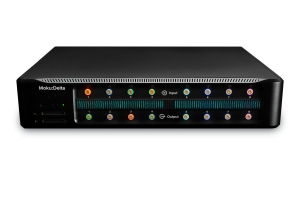
Moku:Delta
Moku:Delta
New
For advanced design and validation
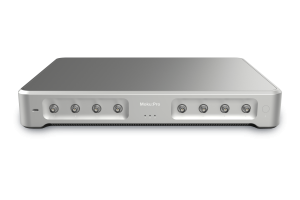
Moku:Pro
Moku:ProFor versatile test and measurement
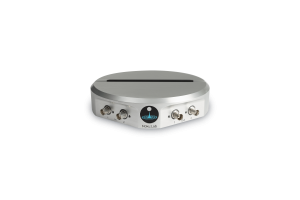
Moku:Lab
Moku:LabFor experimental research labs
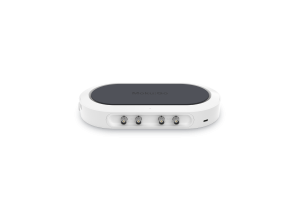
Moku:Go
Moku:GoFor quick testing and debugging
Compare Hardware
Compare HardwareView a side-by-side of all Moku hardware
Technologies
GenInst Studio
New
Generate personalized instruments
Integrated InstrumentsProfessional-grade instruments at your fingertips
Neural NetworkFPGA-powered neural network integration
Multi-Instrument ModeCombine instruments to create a customized test system
Moku CompileCode, compile, and deploy to your Moku's FPGA
Software
MokuOSDownload the Moku app for Windows, macOS, iPadOS & visionOS
APIsPython, MATLAB, LabVIEW
UtilitiesCommand line and graphical tools for file conversion
Instruments
Analysis
Oscilloscope
Spectrum Analyzer
Frequency Response Analyzer
Lock-in Amplifier
Phasemeter
Logic Analyzer / Pattern Generator
Time & Frequency Analyzer
Data Logger
Generation
Waveform Generator
Arbitrary Waveform Generator
Control & Conditioning
PID Controller
Digital Filter Box
FIR Filter Builder
Laser Lock Box
Custom & Utility
GenInst Studio
New
Gigabit Streamer
Custom Instrument
Neural Network
Multi-Instrument Mode
Applications
Optics and Photonics
Microscopy and Spectroscopy
Photon Counting
Quantum Optics
Aerospace and defense
A&D Instrumentation
Component Test
Automated Testing
Semiconductor Test
Control Systems and Bode Analysis
MEMS Testing
AI and Machine Learning
Generative Instrumentation
New
Neural Networks
Education
Education and Research
Resources
App Notes
Blog
Case Studies
Coursework
Guides
Product Documentation
Publications
Webinars
White Papers
Support
Company
Contact Us
About Us
Leadership
Partners
News & Updates
Press
Events Calendar
Careers
Store
Moku:Delta
Moku:Pro
Moku:Go
Upgrade Moku:Pro
Upgrade Moku:Lab
Upgrade Moku:Go
0
Get a quote Buy Now
Build personalized instruments with GenInst Studio in minutes, not months. | Register for the webinar
Case studies

Accelerating microelectromechanical systems (MEMS) design at Oregon State University with Moku:Go

Learn how researchers used software-defined instrumentation to design a low-noise system containing an end-to-end prototype in a single device

March 31, 2023

    Introduction

    Microelectromechanical systems (MEMS) are minuscule but mighty machines, typically ranging from a few micrometers to a few millimeters in size. These tiny workhorses can sense, control, and manipulate their environment at a very small scale. Researchers use them in a range of applications, from sensors to actuators to microfluidics. To ensure their reliability, these devices require extensive testing in a variety of environments, such as testing in a vacuum, verifying performance at different temperatures, and confirming material properties like weight and stiffness. These varying test environments and parameters can be difficult for researchers to achieve or simulate.

    A team of researchers led by associate professor Jason Clark of Oregon State University has patented a new force-feedback technology that increases or decreases the effective mass, damping, or stiffness of MEMS devices. Using Moku:Go for feedback control, Jason’s team is working to demonstrate new methodologies for testing MEMS devices like gyroscopes to streamline and enhance MEMS design.

    Moku:Go (Figure 1) is the most versatile and affordable test hardware in its class. This powerful, FPGA-based solution offers 15+ software-defined instruments in a single device, from quintessential engineering tools like an Oscilloscope to advanced instruments like the Laser Lock Box. The wide array of easy-to-use instruments enables researchers to achieve more, faster, in settings ranging from optics labs to industry R&D facilities.

    Users can switch between instruments seamlessly to optimize their Moku:Go to the tasks at hand. And with Multi-Instrument Mode, users can combine pairs of instruments, like the Lock-in Amplifier and PID Controller, to run simultaneously with lossless interconnection.
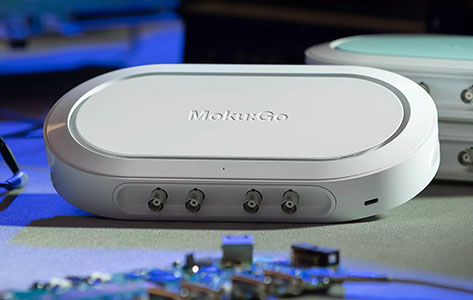
    Moku:Go

    Figure 1: Moku:Go, a compact, versatile device including 12+ software-defined instruments

    The challenge

    Historically, researchers have struggled to coax any two MEMS devices to behave identically. They have tried testing MEMS in a vacuum to achieve a higher resonant frequency, a process that is incredibly expensive and impractical even for the world’s most advanced laboratories. Like Jason and his team, many companies and researchers are now attempting to counteract process variations in MEMS manufacturing that lead to performance inconsistencies. For example, there may be many MEMS devices on a wafer (Figure 2). Even if they’re all meant to resonate at 30 kHz, none of them will successfully resonate at the desired frequency due to process variations in geometry and material properties. In their pioneering research, Jason and his team are using Moku:Go and their force-feedback technology to account for these process variations and force the resonators to resonate at the desired frequency. 
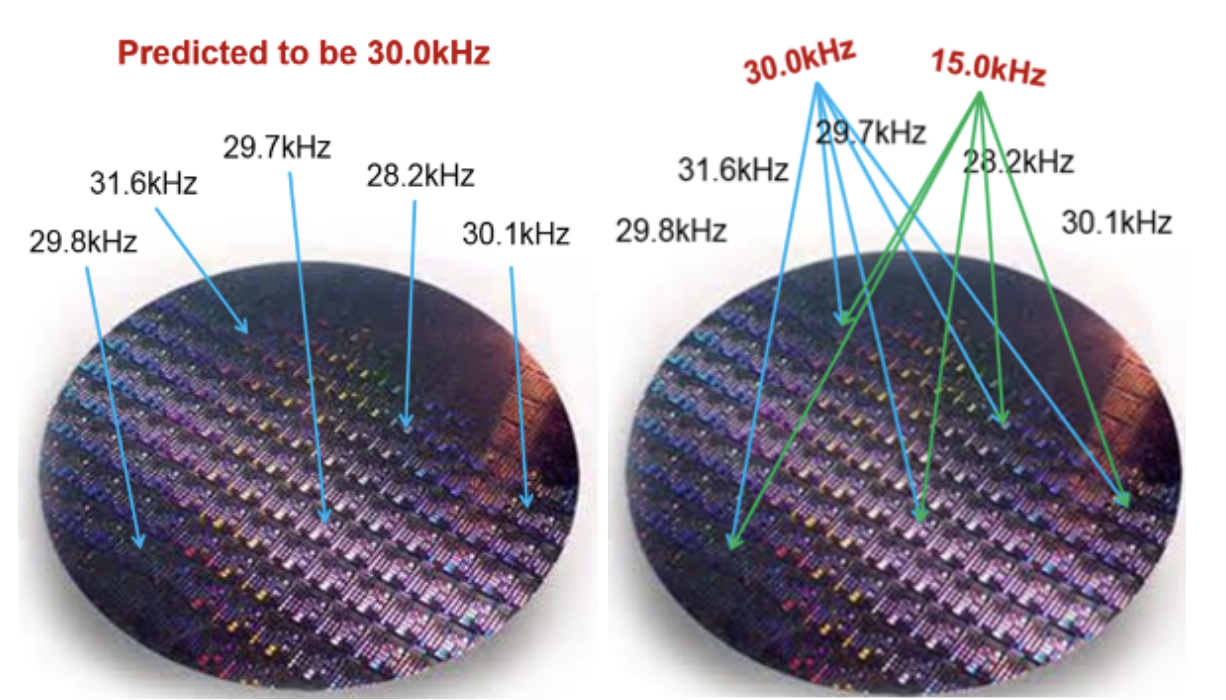
    OSU MEMs wafer

    Figure 2: Left: Resonators before researchers apply force-feedback technology. Right: Resonators after researchers apply force-feedback technology, achieving the desired resonant frequency

    Before selecting Moku:Go, the researchers considered other solutions to create this patented technology, but they found that other FPGA tools were out of budget and not intuitive to use. In addition, the team spent more than three years adjusting analog components and designing circuitry to achieve their goals, but ran into extensive noise issues, halting progress. After purchasing various pieces of equipment to try to solve this issue and spending significant time troubleshooting to identify the source of the noise, the team turned to digital instrumentation. Moku:Go provided an ideal solution, effectively eliminating all analog noise by digitally processing their signals.

    The solution

    Using the Moku:Go PID Controller as the feedback component, Jason’s team is working to prove that they can manipulate a 10 dollar gyroscope to behave like a 10,000 dollar gyroscope. Typically, high-performance gyroscopes increase in cost as the Q-factor, or quality factor, increases (Figure 3). However, by implementing reconfigurable, FPGA-based feedback systems, the team has shown that they no longer need to rely on expensive test environments, such as testing in a vacuum, to advance their research. With their force-feedback technique, a system could behave in air as it would in vacuum, potentially saving thousands of dollars.

    Figure 3: Gyroscope vs. quality factor for popular gyroscope models

    Figure 3: Gyroscope vs. quality factor for popular gyroscope models

    Using the flexibility of Multi-Instrument Mode for Moku:Go, researchers first enable the Lock-in Amplifier to lock to a desired frequency. Then, they seamlessly deploy a PID Controller for feedback control. The researchers then process the signal digitally and analyze the results, all within Moku:Go. By utilizing digital instrumentation, Jason and his team have eliminated their noise issue. They can also quickly and easily reconfigure their digital circuits by adjusting feedback parameters, changing filter corner frequencies, and troubleshooting using the embedded Oscilloscope.

    “Going digital, Yingsong Han is really happy about this because one, he’s going to have much lower noise, and two, it’s easy to change,” said Jason of his graduate student’s success using Moku:Go. “If he wants to change something, we don’t have to buy anything new. He can just redo the setup virtually.”

    The result

    Thanks to the best-in-class performance of Moku:Go, the team can create custom digital signal processing circuitry, leading to groundbreaking discoveries in the MEMS testing field. By using nonlinear feedback from the Moku:Go PID Controller, they achieved unprecedented high-Q, large-bandwidth resonance behavior from inexpensive gyroscopes, seen in Figure 4.

    Figure 4: Bandwidth vs. Q before feedback (blue) and after feedback (red)

    Figure 4: Bandwidth vs. Q before feedback (blue) and after feedback (red)


    Conclusion

    With Moku:Go, Jason and his team have designed a low-noise system that offers an end-to-end prototype contained in a single device, all with minimal troubleshooting. By developing a cost-effective, highly efficient test environment for microelectromechanical systems, they have significantly advanced the MEMS research and design field. As Jason and his team continue to test and optimize their research and patented force-feedback technology, Moku:Go will help transform their designs from ideas to prototypes without any additional expensive instrumentation.

    To learn more about Moku:Go, contact info@liquidinstruments.com.

    To learn more about how Professor Clark is redefining engineering education with Moku:Go, check out his course, Automating the Future with Moku:Go, or listen to his exclusive webinar here.

    Try Moku in demo mode Download the Moku app → Get answers to FAQs Visit Knowledge Base → Connect with Moku users Join the user forum →

    Other Recommended Case studies

    Case studies
    Phase Stabilization for Quantum Key Distribution with Moku:Pro

    Learn how researchers at the University of Hamburg are using Moku to improve signal fidelity for continuous-variable QKD.

    Featuring: Moku:Pro, PID Controller, Lock-in Amplifier, Laser Lock Box

    Date: Mar 16, 2026

    Case studies
    Enabling Dual-Wavelength Nanosecond Fiber Lasers for Multi-Contrast Photoacoustic Imaging with Moku:Pro

    Learn how researchers at the University of Hong Kong used Moku:Pro to generate synchronized shortwave-infrared nanosecond pulses and stabilize modulation depth for dual-wavelength photoacoustic imaging.

    Featuring: Moku:Pro, Waveform Generator, PID Controller

    Date: Dec-19-2025

    Case studies
    Teaching lock-in detection with Moku:Go

    Learn how students at IIT Madras are gaining hands-on experience in using the Lock-in Amplifier instrument on Moku:Go

    Featuring: Moku:Go, Lock-in Amplifier

    Date: Dec-15-2025

    Back to all Case studies

    Nav

    • Products
    • Instruments
    • Resources
    • Support
    • Company
    • Contact Us
    • Privacy Policy
    • Terms of Use

    Offices

    United States
    (619) 332-6230
    12526 High Bluff Dr.
    Suite 150
    San Diego, CA 92130

    Australia
    +61 2 6171 9730
    243 Northbourne Avenue
    Suite 1, Level 1
    Lyneham, ACT 2602

    Australia
    +61 3 7073 3594
    Suite 5C, Level 5,
    700 Swanston Street,
    Carlton, VIC – 3058


    Follow us

    LinkedIn YouTube X Facebook Instagram

    官方微信

    © 2026 Liquid Instruments. All rights reserved.