

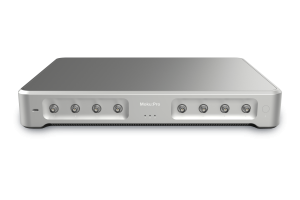

When light carries information, such as in LiDAR and other imaging techniques, it is best to have a strong signal so that the information can be detected and extracted from the carrier with maximum fidelity. For several reasons, this ideal scenario is not always possible. In imaging applications, biological materials can be sensitive to strong illumination, and LiDAR measurements often take place over long distances, reducing the intensity of the received signal. In these cases, the ability to precisely and rapidly perform low-intensity imaging is critical. At the prestigious University of the Chinese Academy of Sciences (UCAS), the group of Dr. Ming-Fei Li is working to improve the cost-effectiveness and speed of low-intensity imaging processes, using a specially designed coding disk to spread out single photons in time. For photon detection, the researchers use Moku:Pro, an FPGA-based device from Liquid Instruments that delivers a reconfigurable suite of test and measurement instruments for fast, flexible signal processing and analysis. Leveraging the Moku Time & Frequency Analyzer as a photon counting module, they can rapidly decode the critical data contained within this spatially modulated light.
The challenge
To measure low-intensity light signals, researchers have made progress in the development of single-photon detectors (SPD). These devices offer incredible sensitivity and time resolution, with the ability to detect energies on the scale of a single photon with picosecond resolution. A complementary technique has also emerged that makes use of the advantages offered by SPDs, called single-pixel imaging (SPI). Rather than using an array of SPDs to mimic a conventional imaging system, the SPI uses a single detector and reconstructs an image from a time-stamped stream of photons. Despite these advances, the issue remains of how to effectively modulate the light so that it can be recovered with the SPI technique. Digital micromirror devices (DMD), consisting of an array of millions of micron-scale mirrors that can be rapidly switched on and off, are common for spatial light modulation. These devices, however, suffer from a slow modulation rate, which limits how fast the object can be imaged. The team at UCAS has designed a spinning coding disk to act as the modulation source, which can modulate the light at a rapid rate. With this approach, the implementation is also more cost-effective than a DMD-based system. However, while this technology is promising, the coding disk approach also brought its own unique challenges, some of which the team addressed with the Moku Time & Frequency Analyzer.
The solution
To determine the effectiveness of their coding disk, the group developed the setup shown in Figure 1. A helium-neon laser illuminates the object, and the transmitted light is then passed through a rotating disk. The disk, which has two parts, rotates at a constant speed. The encoding portion of the disk takes the spatially modulated photons and spreads them out in time for individual detection. These encoded data patterns are synchronized with the detector through an LED, which is optically chopped by a notch on the outside of the disk. The resulting pulse on the “sync” photodiode provides the clock signal, which helped the group overcome one of the main obstacles of the technique — that of variance in the rotation rate.
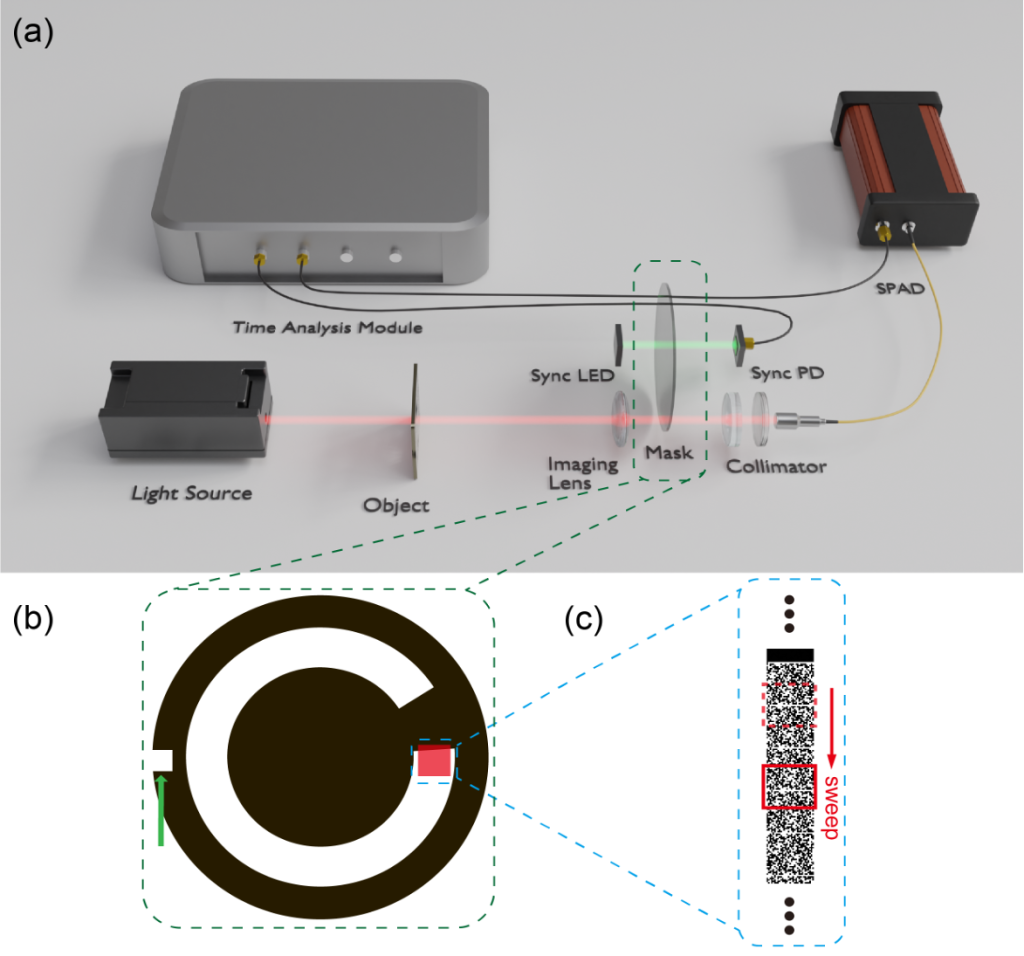
Figure 1: Experimental setup. (a) Imaging setup, featuring Moku:Pro. (b) Top view of the spinning coding mask. Red square: imaging area, green arrow: sync notch. (c) A zoomed-in view of the mask.For detection, the group used two SPDs devices. The first was a more traditional single-photon avalanche diode (SPAD), which operated in the frequency range of 400–1060 nm. They also made use of a superconducting nanowire single-photon detector (SNSPD), which could operate over many wavelengths, such as 1064nm or 1550 nm. These devices operated on different logic — the SPAD outputs a TTL logic pulse when detecting an event, while the SNSPD and the synchronized PD produces an analog voltage. This difference made it difficult for the group to find a usable time counter, as traditional time-correlated single-photon counting (TCSPC) modules are not always compatible with the signals from superconducting SPDs and PD. To address this issue, the group deployed the Time & Frequency Analyzer to count and timestamp the events detected by the SPDs. Graduate student Zi-Qing Zhao, the lead author on the paper, said that the reconfigurable Moku platform delivers several advantages that make the instrument attractive for their research. The first was the ability to change the threshold voltage for events, allowing them to use a single counter for data collection, regardless of frequency range. “We tried another TCSPC, and we could not use it due to the varying amplitude of the superconducting SPD,” he said. Zhao also said the instrument’s trigger delay feature was very helpful, as it helped them to compensate for slight variances in period of the disk’s rotation due to physical instabilities. This correction for rotation speed was a critical step, as it had limited the performance of previous experiments using similar setups.
The result
When making a measurement, the Moku Time & Frequency Analyzer registers events on two input channels simultaneously: one tracking the synchronization pulses, and the other tracking photon events. It then assigns a timestamp to each event. After data collection, the raw timestamp data is converted to CSV format using the Moku File Converter and imported to a host PC for post-processing. Zhao used a Python script for data processing and found that the concise way that Moku formats data vastly simplified his analysis. “Previously, I had to hand-write C++ code for data analysis,” he said. “The way Moku packs and organizes the data makes this much more efficient.” After analysis, the group showed that they were able to perform photon-counting SPI with extremely low illumination (around half a photon per pixel per rotation). An example of their results can be seen in Figure 2. Using their method to correct for the rotation speed, they could integrate over thousands of disk cycles to increase the contrast-to-noise ratio (CNR) of their images. Without applying this correction, the CNR would become worse with more averaging due to the speed fluctuations.
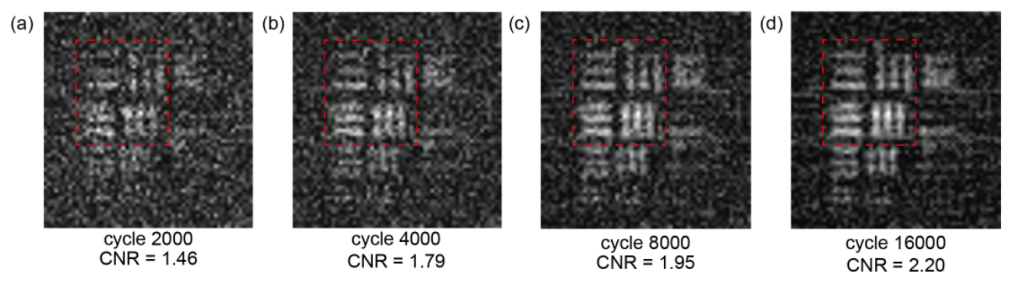
Figure 2: Reconstructed images collected by the SPI technique, showing the effect of integration over many cycles. The CNR increases accordingly with the number of cycles.The group’s experiments demonstrate the potential for spinning coding masks to be used for spatial modulation in imaging applications. The devices have lower cost and compactness relative to DMDs and can provide higher refresh rates for faster imaging. The group’s work is now available from [1]. Looking ahead, Zhao says that the team is developing more single-photon detection experiments, and Moku:Pro will still be their first choice.
References
[1] Zi-Qing Zhao, Yue-Xi Zhang, Jia-Qi Song, Ming-Fei Li, and Ling-An Wu, “Photon-counting single-pixel camera based on a fast spinning coding disk,” Opt. Lett. 50, 169-172 (2025).