
In undergraduate and post-graduate physics labs, it is critical that students not only learn basic electromagnetism concepts, but also familiarize themselves with standard instrumentation such as function generators, oscilloscopes, and spectrum analyzers. Lock-in Amplifiers have use in applications ranging from spectroscopy to quantum optics to MEMS, and many more. Despite this, principles of lock-in detection are usually not taught in many student labs due to the prohibitive cost of Lock-in Amplifiers.
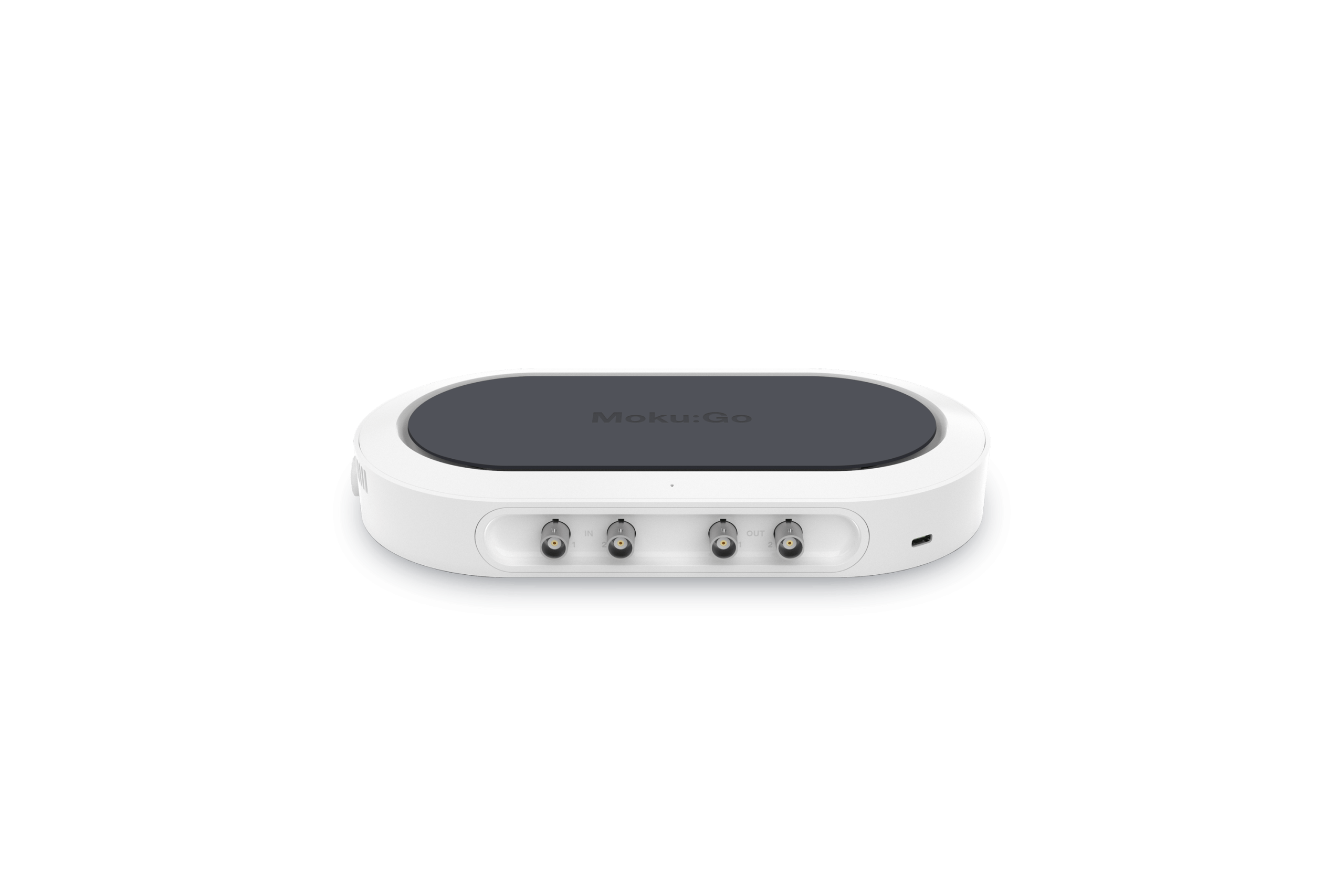
At the Department of Physics, IIT Madras, Moku:Go is used to facilitate hands-on learning of the principles of lock-in detection as part of a lab course. The activity is designed to be a 6hr – 9hr session in a week for individual students (UG and PG).
Moku:Go, is a reconfigurable device that delivers a suite of software-defined test and measurement instruments, including a Waveform Generator, Oscilloscope and Lock-In Amplifier. Using these modules, the following activities have been designed for dozens of students to learn in parallel in a cost-effective manner:
a) Study the effect of locking and not locking the given sinusoidal signal with the internal reference (a sinusoidal signal)
b) Measure a signal that has two frequency components
c) Measure a signal which is a square wave train
d) Measure a very low resistance (below what regular multimeters can measure)
The challenge
Lock-in detection is necessary for applications where the phase and amplitude of a signal need to be measured, such as optical interferometry, RF reflectometry, and many others. Essentially, this method “locks on” to a specific frequency component within a complex signal, isolating and extracting it from its background. By rejecting noise and high-frequency components, lock-in detection provides exceptional sensitivity, with the ability to recover signals that lie beneath the noise floor.
Lock-in detection works by comparing an input signal to a reference, called a local oscillator, set to the desired frequency. The signal is then demodulated at the reference frequency, which in the frequency domain centers the signal at 0 Hz. A lowpass filter then removes any high-frequency components, leaving only the amplitude of the component of interest. Almost all modern Lock-in Amplifiers perform dual-phase demodulation, which uses two local oscillators shifted by 90 degrees to extract both the phase and the amplitude of the incoming signal. A block diagram of a Lock-in Amplifier is seen in Fig. 1.

Despite their ubiquity in physics and engineering research labs, Lock-in Amplifiers are typically expensive compared to other test and measurement devices. This limits their presence in large undergraduate physics labs, where multiple units are required so that all students can have hands-on experience with them.
The solution
The Department of Physics, IIT Madras introduced nine Moku:Go devices for students to individually gain hands-on experience with the Lock-In Amplifier instrument.
In the first exercise, students generate a periodic sine wave and adjust parameters of the Lock-in Amplifier such as input amplitude and LO frequency. They then measure the effects of these parameters on the demodulation amplitude. Using the Moku:Go Waveform Generator in parallel, students also inject noise into the circuit, finding that the signal can still be recovered even with low SNR.
The instrument also provides a precise way to measure AC resistance. The Lock-in Amplifier quantifies the voltage drop of an AC voltage source across one of the resistors in a voltage divider configuration (see Fig. 2). This extracted resistance value is then compared to the nominal value of the resistor. With the added noise rejection of a Lock-in Amplifier, this method provides precision above that of a standard DC voltage divider. It also quantifies any parasitic capacitance of the resistor through the full impedance Z, as opposed to simple DC resistance.

Lastly, the students also used the Moku to measure different harmonics of a square wave. Students input a periodic square wave signal into the Lock-in Amplifier and adjust the local oscillator frequency to the center frequency and then each odd harmonic. By measuring the demodulated amplitude of each harmonic, they could visualize the different components that constitute the square wave, as well as the diminishing amplitude of higher harmonics.
The result
Moku:Go is found to provide a cost-effective way of introducing lock-in amplifier concepts to students. The Department of Physics at IIT Madras is working on designing experiments involving the other instruments in Moku:Go, for example, the PID controller, to teach feedback control concepts to the students.