


At the onset of COVID-19 pandemic, Dr. Andrew Wade and Dr. Kirk McKenzie of the Center for Gravitational Astrophysics at the Australia National University (ANU) were warned that a full shutdown of their lab was imminent, and could last for months. They needed to quickly configure their setup and ensure long-term data collection was possible. After a few calls and emails with the Liquid Instruments team, their experiment was up, running, and remotely accessible.
The experiment
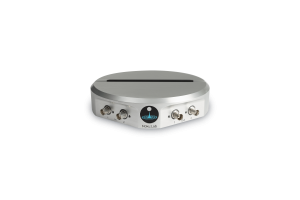
“We had set up a long running measurement to track the stability of an optical frequency reference against a time standard,” said Dr. Wade. “We needed to log slow drifts of our device under test using the Moku:Lab’s Lock-in Amplifier and wanted to check in on the progress of the experiment every few days. Ideally we wanted a month long segment of uninterrupted data.” The equipment itself was not necessarily the problem. “We have a lot of legacy equipment that can collect and digitize data,” Wade explained. Instead, the larger hurdle was accessing the data once it was collected. “Extracting the data from these legacy instruments, often involves many layers of “hacks” to check in and access data remotely over a computer network.” Even though their lab has a custom-built ADC/DAC system for collecting data at moderate sample rates, the short and urgent timeline meant a lot of overhead and a steep learning curve for configuration that the research team could not afford to take on. Dr. Wade’s research lab already had a few Moku:Labs, and he immediately saw the potential to incorporate them into their experiment. “Moku:Lab offered an easy-to-use interface that could be learned, configured and deployed in our setup in a matter of hours,” he said. “The data logger is also built into a number of instruments on the Moku:Lab making it easy to log signals from, for instance, the Laser Lock Box, the Lock-in Amplifier, and directly from the ADC inputs.” In the end, it was clear that Moku:Lab was the best solution to extracting data long term, given its flexibility and easy configuration.
Logging limitations and solution
Even with Moku:Lab’s flexibility, there were limitations to the solution in the face of months of lockout. The research team had set up a measurement to run for a 240 hour period (the default maximum), and were planning to remotely access the lab’s Wifi network to restart the measurement on a weekly basis. About a week after the lab entered full shutdown, Dr. Wade emailed the Liquid Instruments team directly to inquire about maximizing the log time for the Data Logger. Immediately recognizing that this was a solution that stood to benefit not just the ANU Centre for Gravitational Astrophysics’s lab, but many of our customers facing limited lab access, we started working together on a solution. Within a few days, a beta update to the iPad app had been implemented that allowed Dr. Wade to set an arbitrary log time data logging through the Lock-In Amplifier. This update was done entirely in the firmware, with no modification to any of the hardware, and effectively addressed their need to collect a continuous month-long data segment through the Lock-In Amplifier. Given that Dr. Wade and his lab were willing to be guinea pigs for this feature update, the Liquid Instruments team provided hands-on support to ensure the implementation went smoothly. Within a few weeks of the release of the beta to their team, the feature has been fully implemented and passed along to all Moku:Lab users through a simple software update. “We now have an excellent set of data that is 33 days of uninterrupted collection,” said Dr. Wade who is currently working on a peer-reviewed paper for which the data will serve as the basis. “It allowed us to be productive in the lab even through the COVID-19 shutdown. Liquid Instruments worked with us to provide a solution quickly that meant that lab equipment wasn’t sitting idle when we were not able to physically present.” We understand that our customers often see the new possibilities before we do. That’s why we work closely with our customers and act on their feedback to ensure that we maximize the flexibility of our solutions. Since working with Dr. Wade and Dr. McKenzie, we have gone on to enable more remote access capabilities so that our customers can expand their control and monitoring with ease, no matter where they are.
Acknowledgment
We would like to thank Andrew Wade and Kirk McKenzie of the Centre for Gravitational Astrophysics at the Australian National University for providing us with the details of their experiment and feedback. The experiment at the ANU was supported by the ARC Centre of Excellence for Gravitational Wave Discovery.
Have questions or want a printable version?
Please contact us at support@liquidinstruments.com