


To verify and characterize an oscillator, multiple incredibly stable pieces of test equipment are traditionally required. At minimum, the stability of the equipment and reference oscillator must exceed the performance of the device under test (DUT). To assess the long-term stability of a DUT, engineers can make Allan deviation measurements similar to those shown in Figure 1. This technique provides a graphical representation of the noise in a signal over time, making it an important metric to use when assessing the stability of an oscillator.
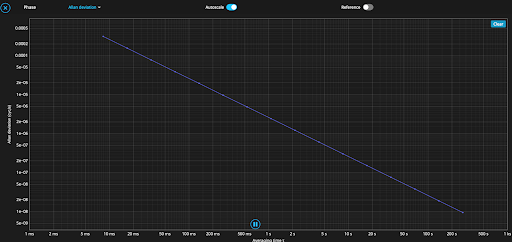
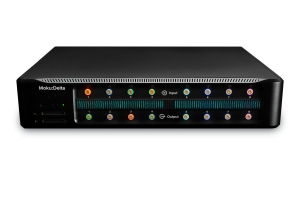
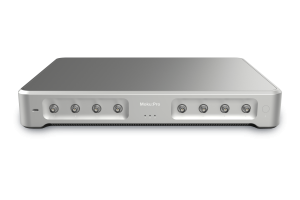
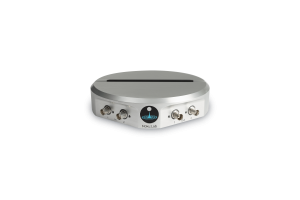
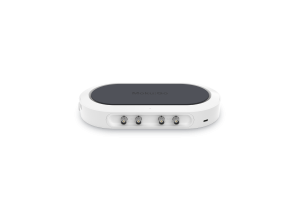
To simplify and accelerate oscillator characterization, Adelmo de Santis, a network and system administrator in the Department of Information Engineering at the Università Politecnica delle Marche in Italy, uses a single device — Moku:Go — to assess the noise floor of the complete measurement system to verify system performance. With this information, he can determine the feasibility of measuring the performance of a rubidium oscillator in his personal lab. With a passion for time and frequency measurements, Adelmo strives to find the most efficient and highest-performing instrumentation to perform his experiments. “After a couple of clicks, Moku:Go was doing exactly what I needed it to for my measurement,” he said. Moku:Go is a reconfigurable, FPGA-based test solution that offers 13+ software-defined instruments in a single device, from quintessential engineering tools like an Oscilloscope to advanced instruments like a Laser Lock Box. The wide array of easy-to-use instruments enables researchers to achieve more, faster, in settings ranging from optics labs to industry R&D facilities.
Challenge
To accurately assess an oscillator’s frequency and stability, engineers must employ frequency counters or references that are far more stable than their DUT. To perform the required Allan deviation measurements, Adelmo previously made measurements in the time domain by providing two pulse-per-second (PPS) signals from a high-precision frequency reference to an HP 53131A frequency counter. To determine the noise floor of the system, he generated one PPS signal and a slightly delayed copy of the same PPS signal. He then collected data over the course of several hours, processed it with TimeLab, and plotted the results in Figure 2.
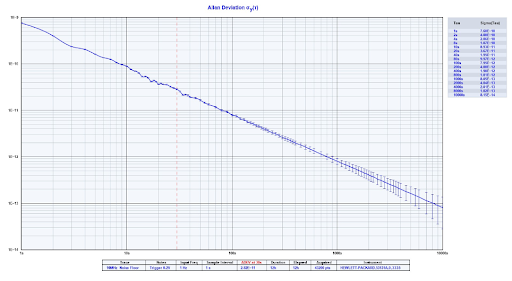
However, with this experimental setup, Adelmo could only sample at 1 Hz, which limited his sample interval to a minimum of 1 second. To extend his Allan deviation measurements to the appropriate level, he tried every existing instrument available in his lab, but none were stable or versatile enough.
Solution
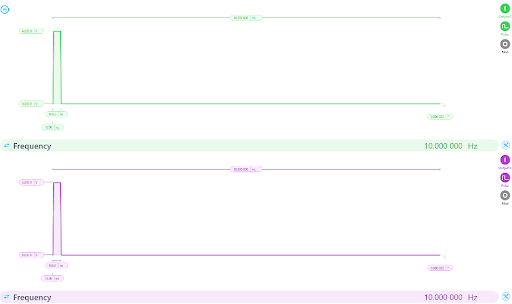
To surpass this sample interval limitation and increase the sampling rate, Adelmo integrated the Moku:Go Waveform Generator into his setup to provide an external trigger signal. The results were outstanding. “It performed far above the previous specification I had,” Adelmo said. The ease of use, small footprint, and performance offered by Moku:Go made it the right solution for the job. With the Moku:Go Waveform Generator, Adelmo generated pulsed signals with a duration of 100 to 200 ns and an amplitude of 4 V, with pulse settings seen in Figure 3.
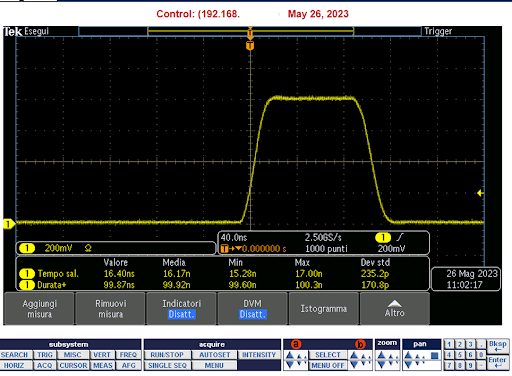
After trying at least three different function generators, Moku:Go proved to be the only one capable of providing this signal with a rise time that was short enough. He verified this observation with an external oscilloscope, as seen in Figure 4. “Moku:Go was simply perfect for my needs,” said Adelmo. “It has excellent performance.”
Result
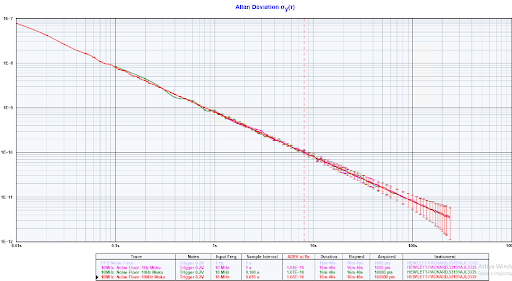
By adjusting the pulse repetition frequency, Adelmo could sample the signals at 10 Hz and 100 Hz, surpassing a previous limitation in his experiment and measuring Allan deviation down to 0.01 seconds, as seen in Figure 5. With this proof of concept complete, Adelmo successfully verified the noise floor of his measurement chain. He plans to set up more experiments with more oscillators soon, again using Moku:Go to provide the trigger signal.
“The thing I love about this device is its ability to solve problems,” he said. “It’s a Swiss army knife in your lab. If you have a problem, you can use Moku:Go to solve it in under an hour. I think it’s really powerful.” Looking ahead, he also plans to explore the functionality of the Moku:Go Phasemeter to test real-time Allan deviation measurement functionality.
Conclusion
Moku:Go eliminates performance limitations while increasing efficiency in Adelmo’s Allan deviation measurements, while also providing a versatile, compact testing platform to speed up various applications within the lab. Curious about how Adelmo’s colleagues are using Moku:Go? Read about unmanned aerial vehicle detection with FMCW radar and Moku:Go here.
Questions?
Get answers to FAQs in our Knowledge Base
If you have a question about a device feature or instrument function, check out our extensive Knowledge Base to find the answers you’re looking for. You can also quickly see popular articles and refine your search by product or topic.
Join our User Forum to stay connected
Want to request a new feature? Have a support tip to share? From use case examples to new feature announcements and more, the User Forum is your one-stop shop for product updates, as well as connection to Liquid Instruments and our global user community.