


Introduction
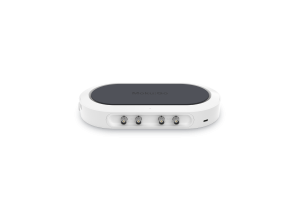
Microelectromechanical systems (MEMS) are minuscule but mighty machines, typically ranging from a few micrometers to a few millimeters in size. These tiny workhorses can sense, control, and manipulate their environment at a very small scale. Researchers use them in a range of applications, from sensors to actuators to microfluidics. To ensure their reliability, these devices require extensive testing in a variety of environments, such as testing in a vacuum, verifying performance at different temperatures, and confirming material properties like weight and stiffness. These varying test environments and parameters can be difficult for researchers to achieve or simulate. A team of researchers led by associate professor Jason Clark of Oregon State University has patented a new force-feedback technology that increases or decreases the effective mass, damping, or stiffness of MEMS devices. Using Moku:Go for feedback control, Jason’s team is working to demonstrate new methodologies for testing MEMS devices like gyroscopes to streamline and enhance MEMS design. Moku:Go (Figure 1) is the most versatile and affordable test hardware in its class. This powerful, FPGA-based solution offers 15+ software-defined instruments in a single device, from quintessential engineering tools like an Oscilloscope to advanced instruments like the Laser Lock Box. The wide array of easy-to-use instruments enables researchers to achieve more, faster, in settings ranging from optics labs to industry R&D facilities. Users can switch between instruments seamlessly to optimize their Moku:Go to the tasks at hand. And with Multi-Instrument Mode, users can combine pairs of instruments, like the Lock-in Amplifier and PID Controller, to run simultaneously with lossless interconnection.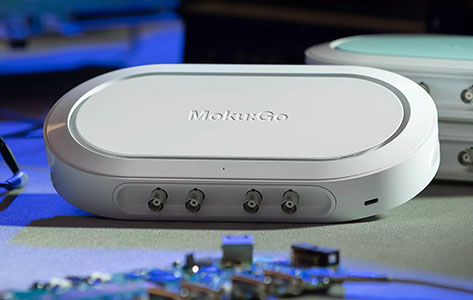
Figure 1: Moku:Go, a compact, versatile device including 12+ software-defined instruments
The challenge
Historically, researchers have struggled to coax any two MEMS devices to behave identically. They have tried testing MEMS in a vacuum to achieve a higher resonant frequency, a process that is incredibly expensive and impractical even for the world’s most advanced laboratories. Like Jason and his team, many companies and researchers are now attempting to counteract process variations in MEMS manufacturing that lead to performance inconsistencies. For example, there may be many MEMS devices on a wafer (Figure 2). Even if they’re all meant to resonate at 30 kHz, none of them will successfully resonate at the desired frequency due to process variations in geometry and material properties. In their pioneering research, Jason and his team are using Moku:Go and their force-feedback technology to account for these process variations and force the resonators to resonate at the desired frequency.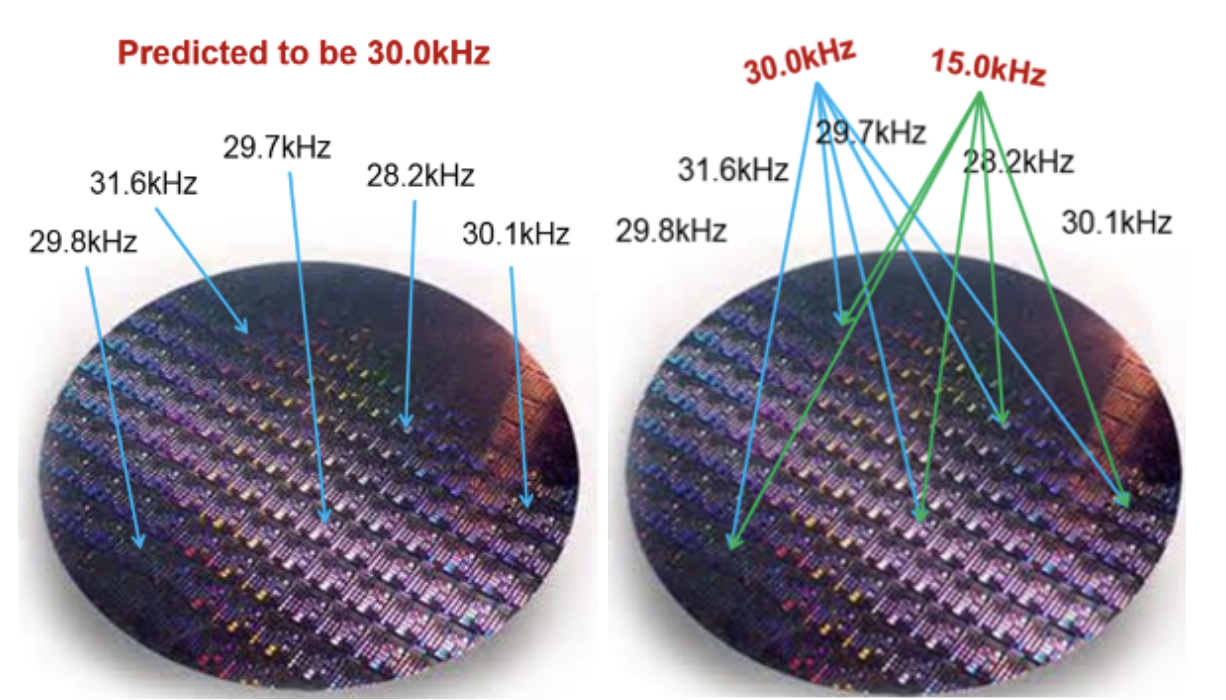
Figure 2: Left: Resonators before researchers apply force-feedback technology. Right: Resonators after researchers apply force-feedback technology, achieving the desired resonant frequency
The solution
Using the Moku:Go PID Controller as the feedback component, Jason’s team is working to prove that they can manipulate a 10 dollar gyroscope to behave like a 10,000 dollar gyroscope. Typically, high-performance gyroscopes increase in cost as the Q-factor, or quality factor, increases (Figure 3). However, by implementing reconfigurable, FPGA-based feedback systems, the team has shown that they no longer need to rely on expensive test environments, such as testing in a vacuum, to advance their research. With their force-feedback technique, a system could behave in air as it would in vacuum, potentially saving thousands of dollars.
Figure 3: Gyroscope vs. quality factor for popular gyroscope models
The result
Thanks to the best-in-class performance of Moku:Go, the team can create custom digital signal processing circuitry, leading to groundbreaking discoveries in the MEMS testing field. By using nonlinear feedback from the Moku:Go PID Controller, they achieved unprecedented high-Q, large-bandwidth resonance behavior from inexpensive gyroscopes, seen in Figure 4.
Figure 4: Bandwidth vs. Q before feedback (blue) and after feedback (red)